料
Character Story & Explanation
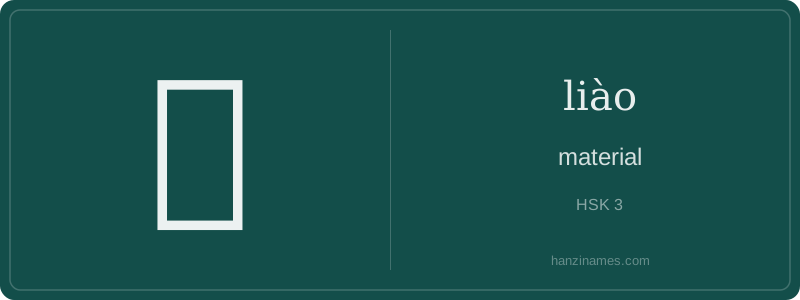
料 appears frequently in modern Chinese life — from food labels (‘本产品不含人工香料’ — 'This product contains no artificial flavoring') to academic contexts (参考资料 cānkǎo zīliào, 'reference materials'). It’s central in the HSK-3 word 资料 (zīliào), used daily in schools and offices. A well-documented idiom is ‘料事如神’ (liào shì rú shén), meaning 'to predict events with divine accuracy', attested in Ming dynasty texts like the Water Margin.
The character’s form combines 米 (mǐ, 'rice') on top — suggesting grain or substance — and 斗 (dǒu, 'measuring dipper') below, historically used to portion out grain. This reflects its original function: measuring or assessing material quantity — a practical, documented usage in ancient granaries and tax records.
Hi students! Let’s explore 料 (liào), a Level 3 HSK character with 10 strokes and the 斗 (dǒu, 'dipper') radical. Though 斗 originally meant a measuring vessel, in 料 it serves mainly as a phonetic component — the pronunciation liào is close to the ancient sound of 斗 in some dialects. Don’t worry about memorizing ancient phonology; just notice how the top part (米) hints at grains or substances, reinforcing the core idea of 'material'.
This character is highly versatile: it means 'material', 'ingredient', or 'substance', but also extends to 'to expect' or 'to reckon' — like thinking through what’s needed before acting. That semantic shift makes sense: if you ‘consider material’ carefully, you’re planning ahead. You’ll see this duality often in Chinese — concrete nouns evolving into abstract verbs through context.
As a beginner, focus first on its most common noun uses: cooking ingredients (食材 shícái), raw materials (原料 yuánliào), or data/material for discussion (资料 zīliào). Pronounce it with the fourth tone — sharp and falling — like saying 'liao!' in surprise when you spot the right ingredient in your pantry!
Example Sentences
Common Compounds
Similar Characters — Don't Mix These Up
Your First Step into Chinese Culture: Get a Chinese Name
Every journey into Chinese begins with a name. Use our free Chinese name generator to create a meaningful, personalized Chinese name that fits you perfectly.
Get My Chinese Name →