斤
Character Story & Explanation
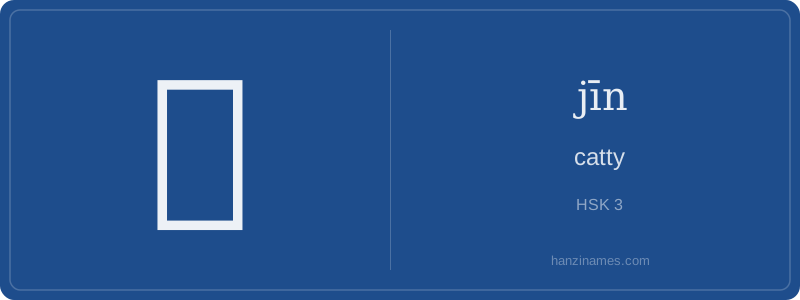
In contemporary China, 斤 is ubiquitous in wet markets, supermarkets, and home kitchens. Vendors routinely quote prices 'per jīn' (e.g., '¥28/jīn for beef'), and recipe apps display ingredient weights in 斤 or 斤两 (jīn liǎng, where 1 jīn = 10 liǎng). The phrase '一斤二两' (yī jīn èr liǎng) — 'one catty, two taels' — remains a common spoken weight expression. Historically, the Qin Dynasty (221–206 BCE) first standardized the jīn at ~253 g; by the Ming and Qing dynasties, it settled near 596 g in some regions before final national standardization to 500 g in 1959.
The character 斤 is a stylized pictograph of an ancient axe or adze—a tool used for chopping wood. Oracle bone and bronze inscriptions show a blade with a handle, evolving into the modern four-stroke form. Its original meaning was 'axe'; the weight sense emerged later through metonymy (the axe being used to weigh or cut measured portions), documented as early as the Warring States period (475–221 BCE).
The Chinese character 斤 (jīn) is a foundational unit of weight in traditional Chinese measurement, equivalent to approximately 500 grams—or half a kilogram—in modern usage. Though officially replaced by the metric system in mainland China since 1959, 斤 remains deeply embedded in daily life, especially in markets, cooking, and informal contexts. Its persistence reflects cultural continuity: people still say 'two jīn of pork' rather than '1 kg', preserving linguistic habits older than the People’s Republic.
Unlike Western units like the pound (≈454 g) or ounce, the catty (jīn) is standardized nationally in China today but historically varied regionally—ranging from 400 g to over 600 g before standardization. This variation mirrors how imperial units evolved differently across Europe, yet 斤 achieved greater uniformity post-1959 than many assume. Its radical status (it *is* its own radical) underscores its lexical importance—it appears in dozens of characters related to cutting, weighing, or tools (e.g., 新 'new', which originally meant 'to cut wood with an axe').
While English speakers may associate 'catty' with the colloquial term for slyness, the Chinese 斤 has no semantic link to behavior—it’s purely a measure. This homophone coincidence offers a useful mnemonic trap to avoid! In education, 斤 appears at HSK Level 3 because learners encounter it early in food shopping, recipes, and health contexts (e.g., weight loss goals). Mastering it unlocks practical communication far beyond textbook exercises—it’s the weight of your lunch, your fruit, and your grandmother’s dumpling filling.
Example Sentences
Common Compounds
Similar Characters — Don't Mix These Up
Your First Step into Chinese Culture: Get a Chinese Name
Every journey into Chinese begins with a name. Use our free Chinese name generator to create a meaningful, personalized Chinese name that fits you perfectly.
Get My Chinese Name →