易
Character Story & Explanation
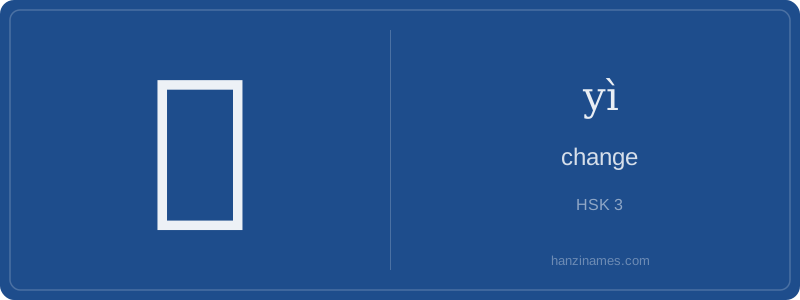
Historically, 易 appears in oracle bone and bronze inscriptions as early as the Shāng dynasty, though its earliest secure usage refers to the Yì Jīng in Warring States bamboo manuscripts (e.g., the Guodian Chu Slips, c. 300 BCE). Today, it’s widely used in academic, philosophical, and spiritual contexts—e.g., university courses on ‘Yìxué’ (易学, ‘Studies of the Book of Changes’) and temple inscriptions. Common idioms include ‘平易近人’ (píng yì jìn rén, ‘approachable and kind’) and ‘显而易见’ (xiǎn ér yì jiàn, ‘obvious’).
The character’s modern form combines 日 (rì, ‘sun/day’) at the top and 勿 (wù, originally a pictograph of a flag or banner with tassels, later repurposed phonetically) below. While not a literal pictograph of ‘change,’ its structure reflects classical phonetic-semantic compounding: 日 suggests brightness/clarity (implying discernment of change), and 勿 provides sound and conveys prohibition or distinction—hinting at discerning *what changes* and *what endures*.
The character 易 (yì) opens a profound window into the Chinese worldview: reality is not static but perpetually transforming. Rooted in the ancient Yì Jīng (Book of Changes), it embodies the Daoist and Confucian insight that change itself is the only constant—governed by patterns, balance (yin-yang), and moral responsiveness. This isn’t chaos; it’s dynamic order, where wisdom lies in perceiving subtle shifts before they manifest.
Unlike Western binaries of ‘change vs. stability,’ 易 integrates both: ease arises *from* understanding change, not avoiding it. The character’s dual connotations—‘change’ and ‘easy’—are not contradictory but dialectical: when one aligns with natural rhythms (as the Yì Jīng teaches through hexagrams and divination), transformation becomes effortless. This reflects a core cultural value: mastery through attunement, not domination.
In practice, 易 shapes ethical reasoning, strategic thinking, and even governance philosophy. Classical texts like the Zuǒ Zhuàn cite rulers consulting the Yì Jīng before decisions. Its influence extends to traditional medicine, feng shui, and martial arts—all systems modeling how forces interact, wax, wane, and transform. To study 易 is to learn a language of flux: one where time is cyclical, causality is relational, and human virtue means flowing *with* change, not against it.
Example Sentences
Common Compounds
Similar Characters — Don't Mix These Up
Your First Step into Chinese Culture: Get a Chinese Name
Every journey into Chinese begins with a name. Use our free Chinese name generator to create a meaningful, personalized Chinese name that fits you perfectly.
Get My Chinese Name →