历
Character Story & Explanation
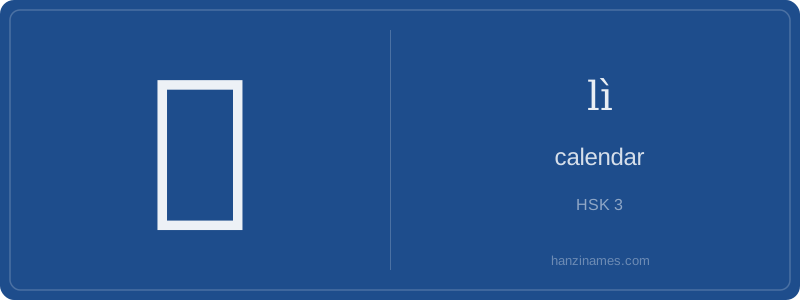
In daily life, 历 appears ubiquitously: on wall calendars (日历 rìlì), official documents (农历 nónglì for the traditional agricultural calendar), and digital interfaces (电子日历 diànzǐ rìlì). The phrase 万年历 wànniánlì ('ten-thousand-year calendar') is a common term for perpetual calendars—both physical almanacs and smartphone apps that display past/future years instantly. A well-documented idiom is 历历在目 lìlì zài mù ('distinctly before one’s eyes'), used when memories surface vividly—highlighting the character’s extended sense of 'chronological clarity.'
Originally a simplified form of 歷 (now the traditional variant), 历 evolved from oracle bone and bronze inscriptions depicting a person walking past a hill or barrier—symbolizing 'passing through time/space'. By the Qin dynasty (3rd c. BCE), it standardized as a phonosemantic compound with 厂 (cliff/overhang radical) and 枹 (a now-obsolete phonetic element), cementing its association with progression and record-keeping.
The Chinese character 历 (lì) is a foundational term for 'calendar'—but its meaning extends beyond mere date-keeping. In Chinese culture, calendars are deeply tied to agriculture, astronomy, and imperial legitimacy; the imperial court historically issued the official calendar (历法 lìfǎ) each year, affirming cosmic order and political authority. Unlike Western Gregorian calendars—standardized globally and secular in origin—Chinese calendars (especially the traditional lunisolar one) integrate solar terms, lunar phases, and festivals like Spring Festival, reflecting harmony between humanity and nature.
Historically, 历 referred to systematic time reckoning: the Xia, Shang, and Zhou dynasties each developed distinct calendrical systems, later refined under Emperor Wu of Han with the Tai-chu Calendar (太初历) in 104 BCE—the first officially promulgated, mathematically rigorous calendar in China. This contrasts with the Gregorian reform of 1582, which corrected astronomical drift but remained ecclesiastically driven and politically fragmented across Europe until widespread adoption centuries later.
Today, 历 retains dual usage: as a noun ('calendar') and verb ('to experience, undergo'), revealing a cultural worldview where time is not just measured but lived through accumulated experience (e.g., 经历 jīnglì 'experience'). This semantic breadth has no direct English equivalent—'calendar' and 'to undergo' are separate lexical domains in English, whereas 历 unifies chronology and biography. It mirrors how Chinese thought often embeds temporal process in human action, unlike Western linear, abstract time concepts rooted in physics or theology.
Example Sentences
Common Compounds
Similar Characters — Don't Mix These Up
Your First Step into Chinese Culture: Get a Chinese Name
Every journey into Chinese begins with a name. Use our free Chinese name generator to create a meaningful, personalized Chinese name that fits you perfectly.
Get My Chinese Name →