更
Character Story & Explanation
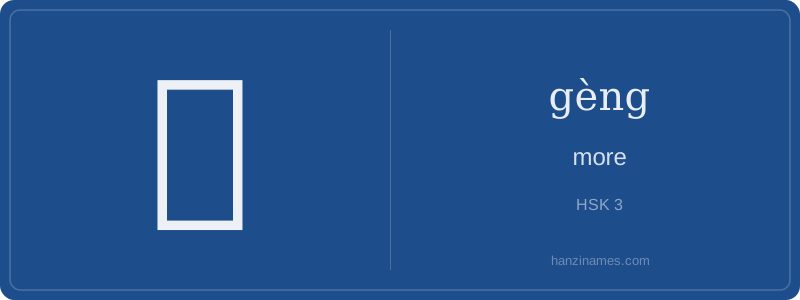
更 is ubiquitous in modern Chinese: it appears in HSK-3+ textbooks, official slogans (e.g., '更开放的中国' — 'a more open China'), and daily speech—especially in comparisons ('他更高了' tā gèng gāo le, 'He’s gotten taller'). It’s essential in idioms like 更上一层楼 (gèng shàng yī céng lóu, 'to ascend one more floor'), from a Tang dynasty poem, meaning 'to make further progress'. The phrase remains a common New Year blessing and corporate motto.
The character’s earliest attested form (in bronze inscriptions, c. 1000 BCE) depicts a hand holding a drumstick striking a drum (鼓 gǔ), symbolizing 'change of watch' or 'timekeeping shift'—hence its original meaning 'to change, to replace'. Over time, this evolved into 'to alternate' (as in 更替 gēngtì), then abstractly to 'further' or 'additional' (gèng), likely via the idea of 'the next watch' implying 'next level'. The modern shape retains 曰 (yuē, 'to speak') as radical, though phonetically unrelated—it’s a later clerical script simplification.
The Chinese character 更 (gèng) functions primarily as an adverb meaning 'more', 'even more', or 'further', intensifying comparisons—much like English comparatives with 'more' or '-er'. Unlike English, it cannot stand alone as a noun or verb; it always modifies adjectives, verbs, or entire clauses. Its usage is tightly bound to comparative structures, especially after the particle 比 (bǐ, 'than'), forming the standard pattern: A 比 B 更 X ('A is more X than B').
While English often uses inflectional suffixes (-er, -est) or separate words ('more', 'most'), 更 provides a consistent, uninflected intensifier across all adjectives—even monosyllabic ones that might otherwise take -er in English (e.g., 更好 gèng hǎo, 'better', not *'gooder'). This regularity simplifies comparative grammar but requires precise syntactic placement: it must precede the adjective/verb it modifies and cannot appear at sentence end.
In Western cultural logic, 更 reflects a relational, context-dependent view of degree—akin to how German 'noch' or French 'encore' can mean 'still' or 'even more' depending on intonation and position. But unlike those, 更 has no temporal ambiguity: it never means 'yet' or 'already' (those are 仍 rēng or 还 hái). Its semantic focus is purely scalar escalation, making it closer to the mathematical notion of 'increment'—a conceptual 'step up' in quality, quantity, or intensity, widely embedded in Chinese rhetoric, education, and policy language (e.g., 更高质量 gèng gāo zhìliàng, 'higher quality').
Example Sentences
Common Compounds
Similar Characters — Don't Mix These Up
Your First Step into Chinese Culture: Get a Chinese Name
Every journey into Chinese begins with a name. Use our free Chinese name generator to create a meaningful, personalized Chinese name that fits you perfectly.
Get My Chinese Name →