末
Character Story & Explanation
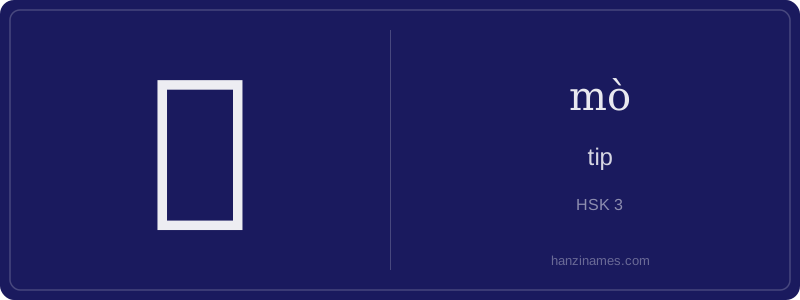
末 appears frequently in modern Mandarin in time-related terms (e.g., 月末 'end of the month'), historical periodization (e.g., 汉末 'late Han dynasty'), and evaluative compounds like 本末倒置 ('putting the cart before the horse'). It is central in the idiom 舍本逐末 ('abandon the root and chase the tip'), recorded in the 3rd-century BCE text *Guanzi*, criticizing misplaced priorities—a concept still invoked in education and policy discourse today.
Historically, 末 evolved from a clear pictographic form in seal script (c. 220 BCE): a horizontal line added above the 木 (tree) radical to indicate 'uppermost part'. Unlike its near-homophone 本 (běn, 'root', with a line *under* the tree), 末’s top stroke visually marks the tip—making its origin one of the most transparent and pedagogically useful distinctions in early Chinese writing.
The character 末 (mò) embodies a subtle yet profound aspect of the Chinese worldview: attention to extremities—not as endpoints to be avoided, but as vital loci of meaning and transition. Unlike Western binaries that often privilege beginnings over endings, classical Chinese thought treats 'tips'—whether of branches, eras, or responsibilities—as sites of clarity, warning, or culmination. This reflects a cyclical, relational ontology where edges are not boundaries but thresholds.
Etymologically tied to wood (木), 末 literally points to the outermost part of a tree—the twig tip, not the root. This grounding in nature underscores Confucian and Daoist sensibilities: wisdom lies in observing subtle signs at the periphery, like the first yellowing leaf signaling autumn’s arrival. The tip is where change becomes visible, where intention meets manifestation.
In governance and ethics, 末 carries evaluative weight: 'the end of an era' (末世) implies moral decline, while 'trivial matters' (末节) signals what is peripheral yet still structurally significant. Thus, 末 teaches discernment—not dismissing the marginal, but reading it with care. It mirrors the Chinese ideal of *zhōngyōng* (the mean): balance requires attending to both root and tip, origin and outcome, substance and surface.
Example Sentences
Common Compounds
Similar Characters — Don't Mix These Up
Your First Step into Chinese Culture: Get a Chinese Name
Every journey into Chinese begins with a name. Use our free Chinese name generator to create a meaningful, personalized Chinese name that fits you perfectly.
Get My Chinese Name →