都
Character Story & Explanation
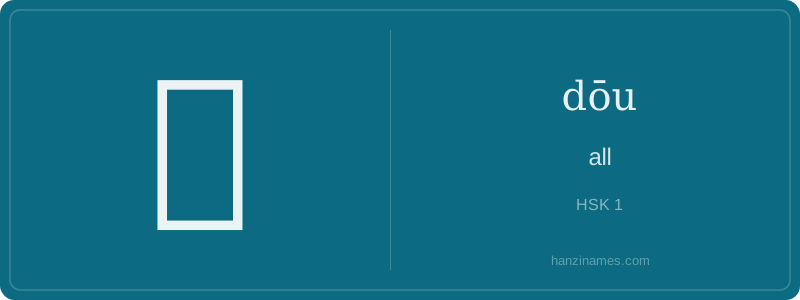
Historically, 都 (dū) denoted major administrative centers—e.g., 北京都 (Beijing capital) in Ming-era documents—and survives in modern place names like 京都 (Kyōto, lit. 'capital city') in Japanese, reflecting its Sino-lexic legacy. In contemporary Mandarin, dōu is indispensable: it appears in over 95% of HSK 1–2 dialogues involving plural subjects or universal claims, and is essential in idioms like 都市 (dūshì, 'metropolis') and 一应俱全 (yī yìng jù quán, 'everything is complete').
The character’s form originates from the seal script variant of 邑 (yì, 'city'), with 阝 representing the 'settlement' radical. Its left component 者 was phonetic, not pictographic—no sun, tree, or animal involved. Modern usage is overwhelmingly dōu: 'All three students passed' → 三个学生都通过了 (Sān gè xuésheng dōu tōngguò le).
Our detective begins at the scene: the character 都, pronounced dōu in its most common usage, appears deceptively simple—but its dual identity (dōu/dū) reveals a layered past. Originally tied to urban administration, 都 began as a noun meaning 'capital city'—a sense preserved in dū—before evolving into the ubiquitous adverbial particle dōu, signaling totality or universality. Its radical 阝 (right ear旁) marks it as a place-related character, anchoring its early meaning in geography and governance.
The shift from concrete noun to abstract quantifier is linguistically telling: by the Tang and Song dynasties, literary texts increasingly used 都 to emphasize completeness—'all', 'even', 'without exception'. This grammaticalization mirrors similar developments in English (e.g., 'all' → 'all gone'). The character didn’t change shape; instead, its function expanded through syntactic repetition and pragmatic reinforcement in spoken and written vernacular.
Today, dōu functions like a spotlight—illuminating scope across subjects, verbs, or clauses. It never stands alone but always modifies: 都去 (all go), 都没来 (none came), 都是 (all are). Its power lies in insistence: it eliminates exceptions. Unlike English ‘all’, which can be a noun or determiner, 都 is strictly an adverb—and its placement before the verb (or adjective) is non-negotiable. This rigid syntax makes it both a cornerstone and a common stumbling block for learners.
Example Sentences
Common Compounds
Similar Characters — Don't Mix These Up
Your First Step into Chinese Culture: Get a Chinese Name
Every journey into Chinese begins with a name. Use our free Chinese name generator to create a meaningful, personalized Chinese name that fits you perfectly.
Get My Chinese Name →