清
Character Story & Explanation
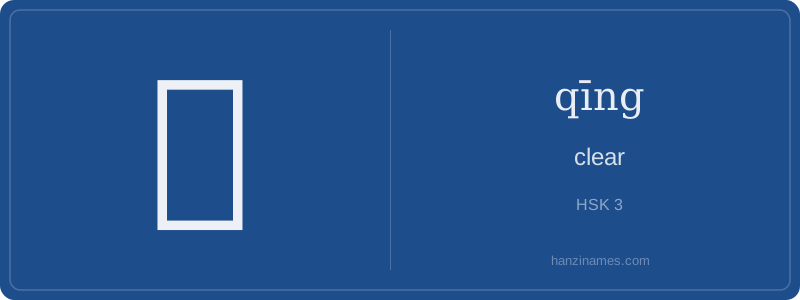
While 清 literally means 'clear' or 'pure,' its use in 'Qing Dynasty' (清朝, Qīng Cháo) is a historical proper noun—chosen by the Manchu rulers to signify moral clarity and cosmic order, aligning themselves with Confucian legitimacy. Common modern uses include 清洁 (qīngjié, 'clean'), 清楚 (qīngchu, 'clear/understandable'), and idioms like 海晏河清 (hǎi yàn hé qīng, 'calm seas and clear rivers'—a metaphor for peace and good governance).
The character evolved from seal script where 氵 (water) + 青 (blue-green) combined phonetically and semantically. 青 originally depicted young plants under sky—symbolizing freshness—and was borrowed for its sound. No oracle-bone form exists; earliest attestation is in Warring States bamboo texts. Today, Chinese people see 清 daily on labels (e.g., 清洁剂 'detergent'), in exams (HSK 3 vocabulary), and in phrases like 清明节 (Qīngmíng Jié, Tomb-Sweeping Day)—linking purity, remembrance, and seasonal clarity.
The character 清 (qīng) embodies a foundational Chinese aesthetic and ethical ideal: clarity—not just of water, but of mind, speech, governance, and moral intent. Its left radical 氵 (water) grounds the concept in nature’s purity, while the right component 青 (qīng, 'blue-green') evokes the unclouded sky or fresh jade—symbols of integrity and renewal. In classical thought, ‘clarity’ is inseparable from virtue: a clear heart (清心) reflects Heaven’s order, and a clear ruler (清官) embodies Confucian righteousness.
This duality—physical transparency and moral lucidity—reveals how Chinese cosmology interweaves natural phenomena with human conduct. Unlike Western binaries of ‘spirit vs. matter,’ 清 treats purity as an active, cultivated state: water must flow freely to stay clear; likewise, the mind must be uncluttered by desire, and administration untainted by corruption. Thus, 清 is not passive cleanliness but dynamic, embodied harmony.
The Qing Dynasty (1644–1912) adopted this character deliberately—not for its association with ‘dynasty’ (which it doesn’t denote alone), but to project legitimacy through Confucian virtue: their rule would be ‘clear,’ just, and harmonious, like pristine water. Though history complicated this ideal, the name itself remains a cultural anchor, reminding learners that Chinese characters encode philosophical commitments far deeper than surface meaning.
Example Sentences
Common Compounds
Similar Characters — Don't Mix These Up
Your First Step into Chinese Culture: Get a Chinese Name
Every journey into Chinese begins with a name. Use our free Chinese name generator to create a meaningful, personalized Chinese name that fits you perfectly.
Get My Chinese Name →