渴
Character Story & Explanation
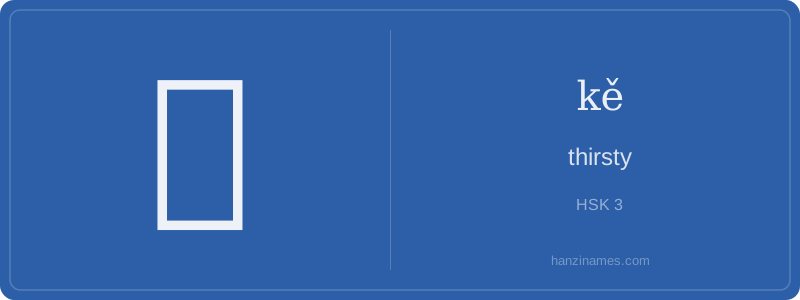
In modern Chinese, 渴 is rarely used alone in speech—it’s predominantly found in compounds like 口渴 (kǒu kě, 'thirsty') or metaphorical phrases such as 渴望 (kě wàng, 'to yearn'). It appears in classical poetry (e.g., Du Fu’s lines on war-induced drought) and contemporary health advisories warning of dehydration. The HSK 3 curriculum emphasizes 渴 in contexts of physical need and emotional longing, reflecting its dual semantic range.
The character’s form is not pictographic but phono-semantic: the water radical 氵 signals meaning (liquid-related states), while 曷 provides pronunciation (hé → kě via sound evolution). No oracle-bone or bronze script form exists—its earliest verified appearance is in seal script (c. 3rd century BCE), where it already bears its modern structural logic: water + voice = bodily urgency demanding response.
As an archaeologist sifting through layers of linguistic sediment, I uncover 渴 not as a static glyph but as a living fossil of embodied experience. Its left radical 氵—three flowing water drops—anchors it in the elemental realm of liquid, survival, and scarcity. The right component 曷 (hé) is phonetic but also historically carried interrogative weight ('why?', 'how?'), suggesting an ancient conceptual link between thirst and urgent questioning—'Why is my throat dry? How do I quench this?' This duality reflects how early Chinese scribes encoded physiology as philosophy.
Excavating oracle bone and bronze inscriptions reveals no trace of 渴 in its earliest forms; it first appears reliably in Warring States bamboo texts and Han dynasty dictionaries like the Shuōwén Jiězì (121 CE), classified under water radicals and defined succinctly as 'dry mouth'. Unlike pictographic characters for 'sun' or 'tree', 渴 emerged later—not from observation of nature, but from introspection on bodily sensation. Its creation marks a cognitive shift: naming internal states with precision, a hallmark of mature written language.
The character’s twelve-stroke structure tells a story of refinement: early variants show 曷 with simplified strokes, but standardization during the Qin and Han dynasties fixed its current form. Each stroke—from the first dot of 氵 to the final horizontal sweep of 曷—was calibrated for brush efficiency and semantic clarity. In excavated administrative documents from Dunhuang, 渴 appears in tax records describing drought-affected counties, revealing how this 'thirst' extended beyond the body to the land and state. It is, then, both visceral and bureaucratic—a testament to language’s dual role in expressing need and managing crisis.
Example Sentences
Common Compounds
Similar Characters — Don't Mix These Up
Your First Step into Chinese Culture: Get a Chinese Name
Every journey into Chinese begins with a name. Use our free Chinese name generator to create a meaningful, personalized Chinese name that fits you perfectly.
Get My Chinese Name →