环
Character Story & Explanation
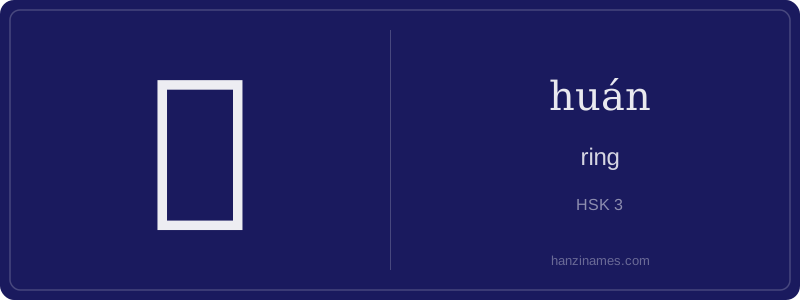
In daily life, 环 appears ubiquitously: in traffic signs (环岛 huándǎo, 'roundabout'), environmental campaigns (环保 huánbǎo, 'eco-protection'), and computing (循环 xúnhuán, 'loop'). Historically, it was central to Zhou dynasty jade rituals — the bi-ring symbolized heaven and was buried with nobles. The idiom 重环 (chónghuán) refers to double jade rings denoting high rank, documented in the Rites of Zhou. Modern usage includes standardized phrases like 北京三环 (Běijīng Sān Huán, 'Beijing’s 3rd Ring Road'), a real infrastructural term since 1994.
The character’s written form originates from a bronze inscription pictograph of a jade ring with a perforated center — confirmed by archaeological finds like the Western Zhou ‘Duke Mao Tripod’. The inner circle (口-like shape) represents the hole; the outer frame, the ring itself. This concrete, object-based origin is well-documented in paleography studies (e.g., Qiu Xigui’s Chinese Writing).
As a detective tracing 环’s evolution, I begin at the Shang dynasty — but here’s the twist: no verified oracle bone inscriptions of 环 exist. The earliest confirmed form appears in bronze inscriptions (zhongdingwen) of the Western Zhou, where it depicts a circular jade ring with a central hole — not as a pictograph of a literal ring, but as a phonetic-semantic compound. The left side, 王 (originally 玉, ‘jade’, simplified to 王 in clerical script), signals its association with precious ritual objects; the right side, 奂 (huàn), provided sound — later evolving into 咸 (xián) and finally simplified to 奂-like shape in modern script.
By the Han dynasty, 环 solidified as a standard character for circular objects — especially jade bi-rings used in ancestral rites and diplomacy. Its semantic scope expanded beyond jewelry: it came to denote any closed loop — geographical (e.g., mountain ranges encircling a basin), conceptual (e.g., cycles, feedback), or mechanical (e.g., gears, links). Crucially, it never meant ‘environment’ on its own; that sense only emerged in modern compounds like 环境 (huánjìng), modeled after Japanese kanji usage in the late 19th century.
The radical shift from 玉 (jade) to 王 (king) is a classic case of clerical-script simplification — where the dot and stroke of 玉 were merged into the three horizontal strokes of 王. This visual ‘cover-up’ obscures its origin but reflects how Chinese writing prioritizes efficiency over transparency. Today, 环 retains its core semantics of closure and continuity — evident in tech terms like 循环 (xúnhuán, ‘loop’) and ecological terms like 环保 (huánbǎo, ‘environmental protection’), both HSK 3–4 staples. Its eight-stroke structure remains stable since the Song dynasty standardization.
Example Sentences
Common Compounds
Similar Characters — Don't Mix These Up
Your First Step into Chinese Culture: Get a Chinese Name
Every journey into Chinese begins with a name. Use our free Chinese name generator to create a meaningful, personalized Chinese name that fits you perfectly.
Get My Chinese Name →