瓶
Character Story & Explanation
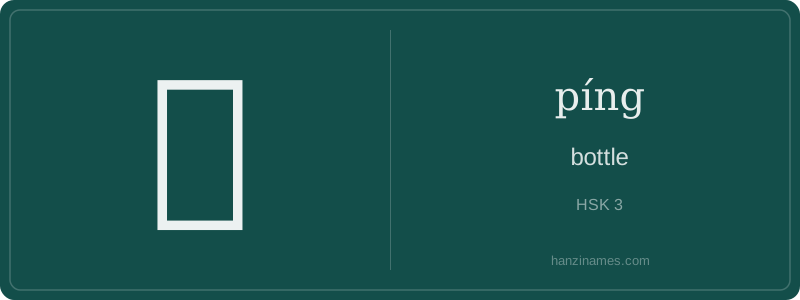
瓶 is ubiquitous in contemporary Chinese life: supermarkets label products with 瓶 counts (e.g., '每箱24瓶'), pharmacies dispense medicine in labeled 瓶, and environmental campaigns urge '空瓶回收' (empty bottle recycling). It appears in the widely used phrase 一瓶水 (yì píng shuǐ) — 'a bottle of water' — cited in official statistics on daily consumption and plastic waste reduction efforts. The State Council’s 2021 plastic pollution control guidelines specifically reference single-use 瓶 as a priority category.
The character evolved from seal script (c. 3rd century BCE), where it clearly depicted a narrow-necked, wide-bellied ceramic vessel with a lid — a direct pictograph of early Chinese stoneware bottles used for wine and grain storage. Archaeological finds from Han dynasty tombs confirm such vessels were standard funerary offerings, inscribed with characters nearly identical to modern 瓶.
The Chinese character 瓶 (píng) means 'bottle' — a container typically made of glass, plastic, or ceramic used for storing liquids like water, wine, or medicine. Unlike English, where 'bottle' is a neutral, general term, 瓶 carries subtle contextual weight in Chinese: it often implies sealed, portable, and standardized packaging — especially in commerce and daily life. Its radical 瓦 (wǎ), meaning 'tile' or 'roof tile', hints at its historical link to fired-clay vessels, reflecting ancient Chinese ceramic craftsmanship.
Western equivalents like 'bottle', 'jar', or 'flask' overlap semantically but differ culturally: a 'bottle' in English may evoke disposability (e.g., plastic water bottles), while 瓶 frequently appears in eco-conscious or traditional contexts — think reusable glass soy sauce bottles in family kitchens or ceremonial wine bottles at weddings. In China, returning empty 瓶 for deposit refunds remains common, reinforcing values of frugality and circular reuse absent in many Western consumer habits.
The character’s ten-stroke structure balances symmetry and function: the left side (병-like shape) suggests containment, while the right 瓦 radical grounds it in material culture. At HSK Level 3, 瓶 is essential for discussing health, shopping, and environment — appearing in phrases like 矿泉水瓶 (mineral water bottle) and 回收瓶 (recycled bottle). Its simplicity belies deep integration into modern sustainability discourse and everyday logistics, from street-side recycling bins to hospital IV bag labels marked with 瓶.
Example Sentences
Common Compounds
Similar Characters — Don't Mix These Up
Your First Step into Chinese Culture: Get a Chinese Name
Every journey into Chinese begins with a name. Use our free Chinese name generator to create a meaningful, personalized Chinese name that fits you perfectly.
Get My Chinese Name →