本
Character Story & Explanation
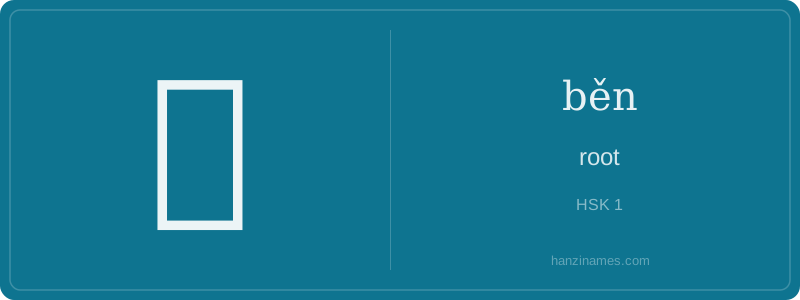
本 is ubiquitous in modern Chinese: it appears in over 200 common compounds, including official terms like 本国 (běnguó, 'home country') and educational staples like 作业本 (zuòyèběn, 'exercise book'). The idiom 本末倒置 (běnmò dàozhì, 'putting the root before the branch') — dating back to the Han Dynasty text *Huainanzi* — warns against confusing fundamentals with details. This reflects the enduring cultural value placed on origins and foundations.
The character originated as a pictograph in early seal script (c. 3rd century BCE): a tree (木) with an added horizontal line (一) beneath its trunk to indicate the root/base — a documented, concrete visual metaphor still visible in today’s standard form. No oracle bone version survives, but the seal script form is well-attested in bronze inscriptions.
Hi students! Let’s learn 本 (běn), a foundational HSK Level 1 character with just five strokes. It belongs to the 木 (mù, 'tree') radical — which tells us it’s related to wood or plant life. Historically, 本 literally meant the 'root' or 'base' of a tree — the part buried in the soil that supports everything above. This core idea of 'origin', 'foundation', or 'source' remains central to all its modern uses.
Even though it looks simple, 本 is incredibly versatile. You’ll see it in words like 本来 (běnlái, 'originally'), 本人 (běnrén, 'the person himself/herself'), and 课本 (kèběn, 'textbook'). Notice how each usage ties back to the idea of 'source' — a textbook is the source of knowledge; 本人 is the original, authentic person. Mastering 本 unlocks dozens of high-frequency words.
Don’t confuse 本 with similar-looking characters like 体 (tǐ, 'body') or 休 (xiū, 'to rest'). Its stroke order is key: first the horizontal line (一), then the vertical line (丨), followed by two short diagonal strokes (丿、丶), and finally the long捺 (nà) stroke at the bottom — like a sturdy tree trunk with roots spreading out. Practice writing it slowly while saying 'běn' aloud to link sound, shape, and meaning.
Example Sentences
Common Compounds
Similar Characters — Don't Mix These Up
Your First Step into Chinese Culture: Get a Chinese Name
Every journey into Chinese begins with a name. Use our free Chinese name generator to create a meaningful, personalized Chinese name that fits you perfectly.
Get My Chinese Name →