去
Character Story & Explanation
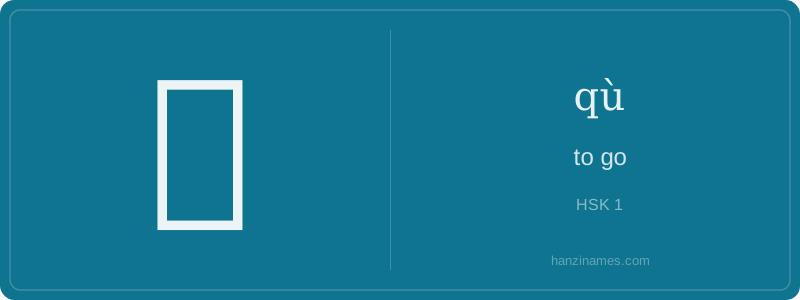
Today, 去 is among the most frequent verbs in spoken and written Mandarin—HSK Level 1 confirms its foundational role. It appears in essential phrases like ‘我去学校’ (I go to school) and idioms such as ‘一去不复返’ (gone forever, from the Han-era *Classic of Poetry* commentary). Historically, it was standard in imperial edicts (e.g., Tang legal codes) to mandate movement: ‘罪人即日去流所’ (the convict shall depart for the penal colony that day).
The character’s form has no verified pictographic origin; oracle bone or bronze inscriptions lack a clear precursor. Modern scholarship (e.g., *Chinese Etymological Dictionary*, Schuessler 2007) treats it as a phono-semantic compound: 厶 (phonetic, ancient *kʷəʔ*) + 大 (archaic variant, suggesting posture/movement). In daily life, Chinese learners first encounter it in classroom commands: ‘请去洗手间’ (Please go to the restroom)—a phrase heard millions of times weekly across schools nationwide.
As an archaeologist brushing dust from a Warring States bamboo slip, I found 去 etched not as a simple verb—but as a spatial operator: a marker of departure *from* a defined point. Its earliest attested forms (c. 4th century BCE) show a person (, later simplified to 厶) stepping *away* from a dwelling (originally 口 or 土), encoding directionality long before grammatical particles existed. This wasn’t just ‘to go’—it was ‘to go *out*, *away*, *off*.’
The radical 厶 (sī), often misread as ‘private,’ actually functions here as a phonetic component with ancient ties to *qù*’s pronunciation—not semantic. Excavated Qin legal texts use 去 repeatedly in administrative orders: ‘去城东’ (go to the east of the city), revealing its bureaucratic precision. Unlike modern casual usage, early 去 carried juridical weight—departure could mean exile, demotion, or tax relocation.
By the Han dynasty, 去 shed its topographic rigidity and absorbed temporal meaning: ‘to go’ into the past (e.g., 去年 *qùnián*, last year). This semantic expansion mirrors how Chinese grammar repurposes spatial verbs for time—a cognitive fossil visible in excavated calendars and household ledgers. The character’s five-stroke form stabilized under clerical script reforms, preserving its directional core while enabling abstract use. It’s not a relic—it’s a living stratigraphic layer.
Example Sentences
Common Compounds
Similar Characters — Don't Mix These Up
Your First Step into Chinese Culture: Get a Chinese Name
Every journey into Chinese begins with a name. Use our free Chinese name generator to create a meaningful, personalized Chinese name that fits you perfectly.
Get My Chinese Name →