好
Character Story & Explanation
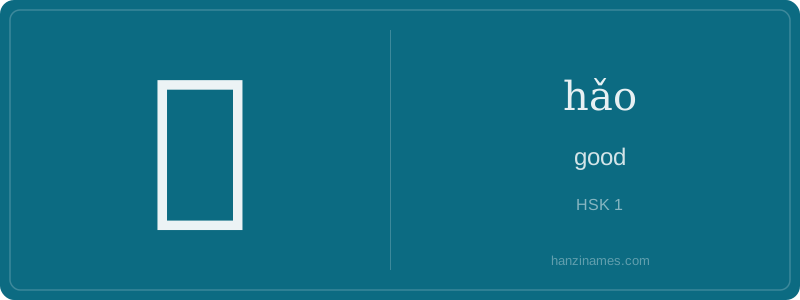
好 is ubiquitous in modern Chinese life: it’s the first word children learn to say (as in 你好 nǐ hǎo), the go-to response to 'How are you?' (我很好 wǒ hěn hǎo), and essential in politeness formulas like 谢谢,很好! (xièxie, hěn hǎo! — 'Thanks, very good!'). It appears in idioms like 好事多磨 (hǎo shì duō mó, 'good things take time') and the historical phrase 好古 (hào gǔ, 'fond of antiquity'), used by Han dynasty scholars to describe reverence for classical texts.
The character’s form dates to the Oracle Bone Script (c. 1200 BCE), where it clearly depicts a woman (女) beside a child (子). Archaeological consensus confirms this as a semantic compound—not pictographic, but ideographic: 'a woman with a child' signified auspiciousness, fertility, and familial harmony, the bedrock of 'goodness' in early Zhou dynasty cosmology.
The character 好 (hǎo) embodies a foundational Chinese value: harmony through relational balance. Its composition—女 (woman) + 子 (child)—reflects an ancient worldview where 'goodness' arises not from abstract ideals, but from nurturing, familial bonds and social propriety. In classical thought, 'good' is inherently relational: a person is 'good' when fulfilling their role with care—mother to child, ruler to people, friend to friend. This stands in contrast to Western notions of individual moral virtue divorced from context.
Even its dual pronunciation reveals cultural nuance: hǎo denotes descriptive or evaluative 'goodness' (e.g., good weather), while hào expresses deep, active inclination ('to like' or 'to be fond of'). This linguistic duality mirrors Confucian emphasis on both outward conduct (hǎo) and inward sincerity (hào). The character thus encodes a philosophy where ethics live in action, emotion, and relationship—not just judgment.
Historically, 好 appears over 200 times in the Analects of Confucius, often paired with terms like 德 (virtue) and 礼 (ritual propriety). Its early bronze inscriptions (c. 11th–3rd century BCE) already carried meanings of 'auspicious', 'harmonious', and 'fitting'. This continuity underscores how deeply embedded the idea of relational goodness is in Chinese civilization—where 'being good' means aligning with natural order, social roles, and heartfelt intention, all at once.
Example Sentences
Common Compounds
Similar Characters — Don't Mix These Up
Your First Step into Chinese Culture: Get a Chinese Name
Every journey into Chinese begins with a name. Use our free Chinese name generator to create a meaningful, personalized Chinese name that fits you perfectly.
Get My Chinese Name →