目
Character Story & Explanation
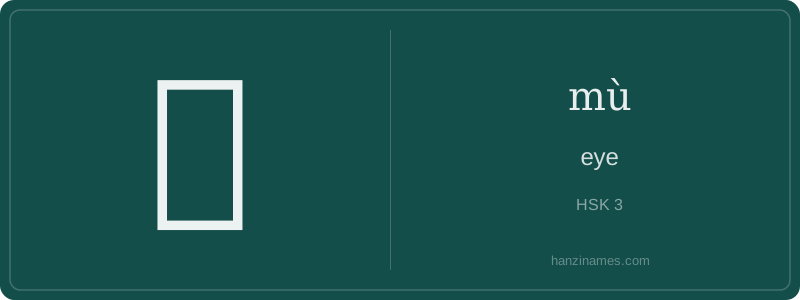
目 remains deeply embedded in modern Chinese usage: it appears in HSK 3 vocabulary like 目光 (mùguāng, 'gaze'), 目标 (mùbiāo, 'goal' — literally 'eye target'), and idioms such as 一目了然 (yī mù liǎo rán, 'clear at a glance'). Historically, it functioned as both a standalone noun ('eye') and a semantic component in compound characters (e.g., 看 kàn 'to look', 睛 jīng 'eyeball'). Its radical status (as Radical 109) confirms its foundational role in vision-related lexicon.
Archaeological evidence confirms 目 originated as a pictograph — oracle bone inscriptions clearly depict a human eye with iris/pupil detail. No scholarly debate exists on this origin; it’s one of the most unambiguous pictographs in the Chinese writing system, widely documented in paleography sources like Qiu Xigui’s *Chinese Writing*.
As a detective tracing the evolution of 目 (mù), I begin at the crime scene: oracle bone inscriptions (c. 1200 BCE). There, 目 appears unmistakably as a stylized eye — a rectangular outline with two horizontal lines inside representing pupils. It wasn’t abstract; it was observational forensics — early scribes capturing anatomy with astonishing fidelity. This wasn’t symbolism; it was visual documentation, like a forensic sketch made in ink and bone.
Fast-forward to the bronze script era: the shape becomes more refined but retains its core features — the outer frame and inner dashes remain central. By the small seal script (Qin dynasty), the character solidifies into a symmetrical, balanced form that closely resembles today’s standard. The five strokes weren’t arbitrary: each corresponds to a structural element — top lid, left side, pupil line, right side, bottom lid — preserving ocular logic across millennia.
What’s remarkable is how little this character changed over 3,000 years. While most Chinese characters evolved dramatically or merged phonetically, 目 stayed true to its pictographic roots. Even modern simplified Chinese retains its original silhouette. This stability makes it a rare linguistic fossil — a direct visual echo of ancient perception, where ‘seeing’ was literally encoded in the shape of the eye itself.
Example Sentences
Common Compounds
Similar Characters — Don't Mix These Up
Your First Step into Chinese Culture: Get a Chinese Name
Every journey into Chinese begins with a name. Use our free Chinese name generator to create a meaningful, personalized Chinese name that fits you perfectly.
Get My Chinese Name →