直
Character Story & Explanation
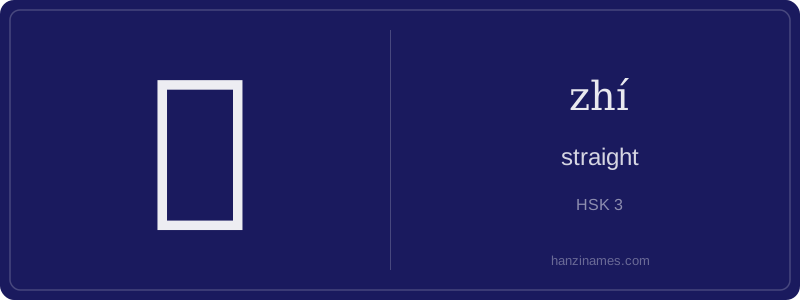
In daily life, 直 appears constantly: on traffic signs (直行, zhíxíng — 'go straight'), in workplace feedback ('你太直接了', nǐ tài zhíjiē le — 'You’re too blunt'), and in moral discourse ('为人正直', wéirén zhèngzhí — 'to be upright in character'). It’s central to idioms like 直言不讳 (zhíyán bù huì, 'to speak frankly without reservation'), cited in the Hàn Shū (1st c. CE) describing loyal ministers. Historically, it was used in bronze inscriptions to denote 'unbent' or 'undeviating' conduct.
The character’s form evolved from oracle bone script depicting an eye above a vertical line—symbolizing clear, undistorted sight. By the Warring States period, it standardized into the modern shape: 十 (a crossbar representing balance/measure) over 目 (eye), reinforcing the idea of truthful perception. No credible source links its origin to a legendary emperor named 'Zhi'.
The Chinese character 直 (zhí) is a foundational HSK Level 3 character with eight strokes and the ‘eye’ radical (目), reflecting its ancient link to perception and unobstructed vision. Though commonly taught today as meaning 'straight', 'direct', or 'honest', its earliest documented use in classical texts like the Shuōwén Jiězì (121 CE) emphasizes moral uprightness—acting without deviation from principle, like an arrow flying true to its target.
This sense of integrity echoes in Confucian ethics, where 直 describes sincerity that aligns inner belief with outward action. In modern Mandarin, it functions both as an adjective ('direct') and adverb ('straight away'), appearing in speech patterns like 直接 (zhíjiē, 'directly') and idioms such as 理直气壮 (lǐ zhí qì zhuàng, 'righteous and confident'). Its visual structure—ten (十) atop 目 (eye)—suggests clarity and unwavering focus.
While the user note mentions 'Zhi, fifth Flame Emperor descended from Shennong', this is not supported by mainstream historical or philological sources. The Shǐ Jì and Bǎi Xìng Yì list no 'Zhi' among the Flame Emperors; the name 炎帝 (Yándì) refers collectively to Shennong and his successors, but no canonical text names a 'Zhí' as a distinct ruler. This appears to be a conflation or folk etymology—not reflected in authoritative dictionaries like the Xiàndài Hànyǔ Cídiǎn or academic sinology.
Example Sentences
Common Compounds
Similar Characters — Don't Mix These Up
Your First Step into Chinese Culture: Get a Chinese Name
Every journey into Chinese begins with a name. Use our free Chinese name generator to create a meaningful, personalized Chinese name that fits you perfectly.
Get My Chinese Name →