短
Character Story & Explanation
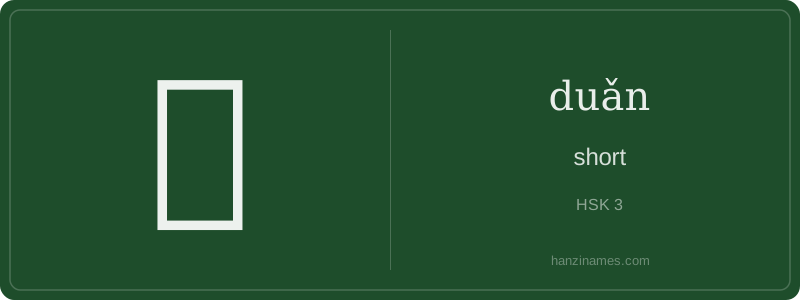
短 is ubiquitous in modern Mandarin: used daily to describe time ('short meeting'), distance ('short walk'), attention span ('short attention'), and personal limitations ('short temper'). It appears in core idioms like 取长补短 (qǔ cháng bǔ duǎn)—'take strengths and compensate for weaknesses'—a principle embedded in Chinese education and management philosophy. Historically, it appears in the *Zuo Zhuan* (c. 4th century BCE) describing military strategy: 'short supply lines' (粮道甚短) were valued for efficiency and control.
The character’s form derives from the ancient radical 矢 (shǐ, 'arrow')—a pictograph of an arrow with shaft and fletching—and the phonetic component 豆 (dòu, originally a ceremonial food vessel). In seal script, the upper part clearly resembles an arrowhead; the 'shortness' arises from the arrow’s compact, ready-to-fire form—symbolizing immediacy and limitation. No oracle-bone form survives, but bronze inscriptions (c. 1000 BCE) already use 短 to denote brevity in ritual durations.
The character 短 (duǎn) embodies a foundational Chinese conceptual duality: it measures not just physical length, but also temporal duration, moral capacity, and even social appropriateness. Unlike English 'short', which is largely neutral or descriptive, 短 often carries evaluative weight—'shortcomings' (短处) are not merely absent traits but ethical or practical deficits requiring cultivation. This reflects the Confucian worldview where human qualities are dynamic, improvable, and relational rather than fixed.
In classical texts like the *Analects*, 短 appears in judgments of virtue: a ruler’s ‘shortness’ in benevolence (仁之短) signals imbalance in moral cultivation—not failure, but an invitation to self-reflection and growth. The character thus encodes a process-oriented ethics: being ‘short’ is never final; it is a diagnostic marker on the path of self-cultivation (修身), aligning with the Daoist and Confucian ideal of continual adjustment and harmony.
Even linguistically, 短 resists absolutism. Paired with measure words (e.g., 一截短, 一段短), it emphasizes relativity—something is short only in relation to a norm or context. This mirrors the Chinese philosophical preference for correlative thinking over binary oppositions: ‘short’ gains meaning only against ‘long’ (长), and both exist in interdependent flux, echoing the yin-yang principle. Thus, 短 is not a static label but a relational lens through which the world is ethically and aesthetically calibrated.
Example Sentences
Common Compounds
Similar Characters — Don't Mix These Up
Your First Step into Chinese Culture: Get a Chinese Name
Every journey into Chinese begins with a name. Use our free Chinese name generator to create a meaningful, personalized Chinese name that fits you perfectly.
Get My Chinese Name →