矮
Character Story & Explanation
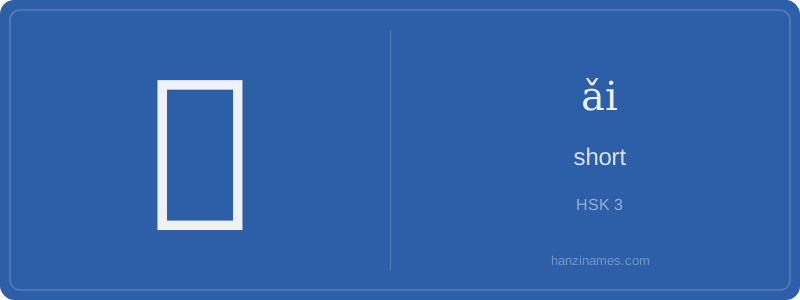
矮 appears frequently in modern Chinese speech and writing — especially in health, education, and media contexts discussing growth standards. For example, the National Health Commission publishes annual '矮小症' (ǎixiǎozhèng, 'short stature disorder') guidelines for pediatric care. It also appears in idioms like '矮子看戏' (ǎizǐ kàn xì, 'a short person watching a play') — a metaphor for blindly following others without understanding. This idiom dates back to Qing dynasty satirical writings and remains widely quoted today.
The character’s form has evolved from seal script but is not a pictograph. Its left side 矢 (arrow) reflects ancient associations with measurement and alignment; the right side 女 (nǚ, 'woman') was later simplified to 矢 + 女 → 矮 in clerical script. In daily life, Chinese parents might ask a doctor: '我家孩子是不是有点矮?' ('Is my child a bit short?') during routine check-ups — a very real, frequent usage.
Hi students! Today we’re learning 矮 (ǎi), which means 'short' — especially when describing a person’s height. It’s an HSK Level 3 character, so it’s common in daily conversation and beginner textbooks. Unlike generic words for 'small', 矮 specifically refers to vertical stature: think of someone who is shorter than average, not something tiny or miniature. It’s often used in comparisons ('He is shorter than his brother') or descriptions ('a short building').
This character belongs to the 矢 (shǐ) radical — meaning 'arrow'. Don’t worry; it’s not about arrows! Many characters with this radical relate to measurement, direction, or precision — historically linked to archery targets and distance judgment. So 矮 subtly carries the idea of relative height measured against a standard.
Remember: 矮 is *not* used for objects that are low in position (like 'low table'), nor for abstract concepts like 'low rank' — those use different characters like 低 (dī). Also, avoid confusing it with 小 (xiǎo, 'small') — you wouldn’t say '矮孩子' for 'a young child'; that’s 小孩子. Practice using 矮 only when height is the focus!
Example Sentences
Common Compounds
Similar Characters — Don't Mix These Up
Your First Step into Chinese Culture: Get a Chinese Name
Every journey into Chinese begins with a name. Use our free Chinese name generator to create a meaningful, personalized Chinese name that fits you perfectly.
Get My Chinese Name →