答
Character Story & Explanation
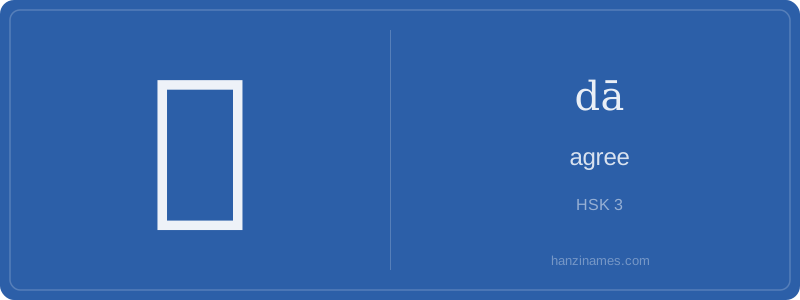
In daily life, 答 (dā) appears almost exclusively in 答應 (dāyìng, 'to agree/consent') and 答理 (dāli, 'to acknowledge/respond to someone'). These are common in spoken Mandarin: parents say '你答應我了!' (Nǐ dāyìng wǒ le! — 'You promised me!'), and ignoring someone may be described as '不答理他' (bù dāli tā — 'won’t even acknowledge him'). Historically, 答應 appears in Qing-dynasty vernacular fiction like *Dream of the Red Chamber*, confirming its long-standing role in expressing verbal commitment.
The character’s earliest documented form (in seal script, c. 3rd century BCE) combines ⺮ (bamboo) and 合 (hé, 'to join/closure'), suggesting 'a written agreement sealed together' — fitting for its modern sense of promising or consenting. While the bamboo component no longer reflects literal usage, it anchors the character in China’s tradition of recording commitments on bamboo slips.
Hi students! Let’s learn the character 答 (dā). It’s a bound form — meaning it almost never stands alone in modern speech or writing. You’ll see it only inside compound words, especially 答應 (dāyìng), meaning 'to agree' or 'to promise'. Unlike the free word 答 (dá) — which means 'to answer' and appears in sentences like 'He answered the question' — this dā pronunciation is restricted to fixed combinations. Think of it like English ‘-ceive’ in ‘receive’ or ‘perceive’: you wouldn’t say just ‘ceive’ by itself!
The character has 12 strokes and belongs to the bamboo (⺮) radical — historically linked to writing materials, since ancient Chinese wrote on bamboo slips. Even though 答 isn’t literally about bamboo, its inclusion reflects how early characters were grouped by shared semantic fields. This radical helps you categorize and remember it among other ⺮-related characters like 笑 (xiào, to laugh) or 笔 (bǐ, pen).
Don’t confuse 答 (dā) with 答 (dá) — they’re the same character but with different pronunciations and uses. The dā reading is *only* for compounds like 答應 or 答理; dá is used for verbs like 回答 (huídá, to answer) or 提问与回答 (tíwèn yǔ huídá, questions and answers). Mastering this distinction is key for HSK Level 3 fluency — it shows up often in listening comprehension and reading tasks involving agreements, promises, or social responses.
Example Sentences
Common Compounds
Similar Characters — Don't Mix These Up
Your First Step into Chinese Culture: Get a Chinese Name
Every journey into Chinese begins with a name. Use our free Chinese name generator to create a meaningful, personalized Chinese name that fits you perfectly.
Get My Chinese Name →