者
Character Story & Explanation
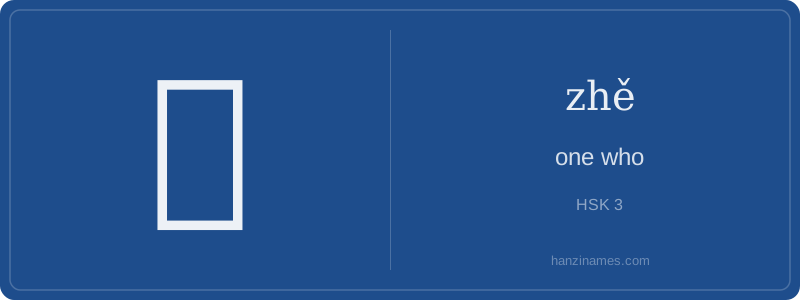
者 is indispensable in formal and literary Chinese—not as a standalone word, but as a nominalizing suffix. It appears in HSK 3+ vocabulary like 作者 (zuòzhě, 'author'), 学者 (xuézhě, 'scholar'), and 执笔者 (zhíbǐzhě, 'writer'). Classical texts use it pervasively: Confucius’ '知之者不如好之者' ('Those who know it are not equal to those who love it') hinges on 者 to mark subject groups. It also anchors idioms like '来者不善' ('the one who comes is not well-intentioned').
The character’s earliest attested form is in Warring States bamboo slips (4th c. BCE), where it already functions grammatically—not pictorially. No oracle-bone form exists. Today, Chinese students learn it via stroke order drills and compound patterns, not etymology. You’ll see it daily in news headlines (肇事者), academic papers (研究者), and even food labels (素食者, 'vegetarian').
Our detective work begins with the oracle-bone and bronze inscriptions—but here, the trail goes cold: 者 has no verified pictographic origin. Unlike sun (日) or tree (木), it emerged as a phonetic-semantic compound in early seal script, not a drawing of a thing. Scholars agree it originally functioned as a grammatical particle—perhaps marking nominalization—long before settling into its modern role as a suffix meaning 'one who…'. Its form stabilized by the Han dynasty, shedding earlier variant shapes.
The radical 耂 (lǎo, 'old') is key—not because 者 means 'elder', but because it signals semantic kinship with aging, experience, and authority. This isn’t literal age; it’s conceptual weight. In classical texts like the Analects and Mencius, 者 consistently marks agents: the one who acts, speaks, or embodies a quality. It transforms verbs and adjectives into noun phrases—like adding '-er' or '-ist' in English, but far more grammatically essential in Chinese.
Though now classified as an 8-stroke character in standard script, its stroke count reflects clerical script regularization—not ancient structure. The dot (丶) at the top, once possibly a phonetic hint, became a fixed component. Modern learners must treat 者 not as a standalone word, but as a grammatical lens: it doesn’t name a person—it *defines* them by action or state. That’s why it appears in titles (作者, 'author'), philosophical terms (学者, 'scholar'), and legal language (肇事者, 'perpetrator')—always pointing to agency.
Example Sentences
Common Compounds
Similar Characters — Don't Mix These Up
Your First Step into Chinese Culture: Get a Chinese Name
Every journey into Chinese begins with a name. Use our free Chinese name generator to create a meaningful, personalized Chinese name that fits you perfectly.
Get My Chinese Name →