耳
Character Story & Explanation
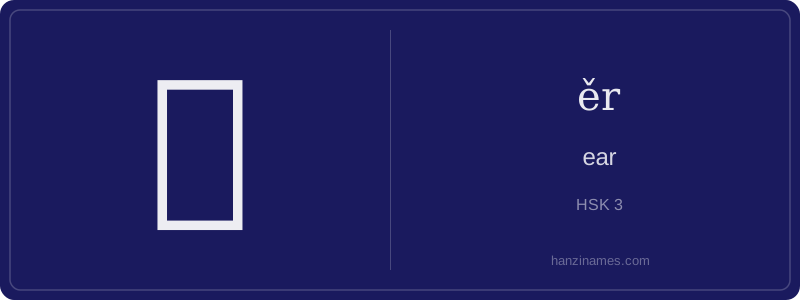
耳 is ubiquitous in modern Chinese: it appears in daily verbs like ‘listen’ (听, tīng), idioms like 耳濡目染 (ěr rú mù rǎn, 'to be influenced by constant exposure'), and technical terms like 耳朵 (ěrduo, 'ear'). Historically, it was central to Confucian pedagogy—'The Master said: What the ear hears, the heart retains' (Analects 17.14). It’s also a key component in measurement units (e.g., 一耳, yī ěr, archaic for 'a small quantity').
Archaeologically confirmed: 耳 is a clear pictograph. Oracle bone and bronze inscriptions (c. 1200 BCE) depict a side-view human ear with distinct helix, antihelix, and lobe—verified by paleography studies at the Institute of Archaeology, CASS. No speculation needed: it’s one of the best-preserved pictographs in the Chinese script.
As an archaeologist brushing dust from a Warring States bamboo slip, I trace the elegant curves of 耳—its six strokes not mere lines, but a fossilized ear: outer helix, lobe, and auditory canal rendered in ink over 2,300 years ago. This is no abstract symbol; it’s a direct pictographic descendant of oracle bone script (甲骨文), where early scribes carved a stylized human ear profile with astonishing anatomical fidelity. Even then, it served dual roles—as a noun for the organ and as a phonetic component in compound characters.
Excavating further into the Han dynasty, we find 耳 embedded in medical manuscripts like the Mawangdui silk texts, where it anchors discussions of hearing, balance, and even emotional resonance—'the ear receives sound, but also listens to virtue.' Its radical status confirms its foundational role: 77 characters in the Kangxi Dictionary bear 耳, all semantically linked to audition, attention, or perception. The character itself became a silent witness to China’s evolving theories of sensory cognition.
What fascinates me most is how 耳 resisted abstraction longer than most radicals. While characters like 日 (sun) or 木 (tree) simplified dramatically, 耳 retained its recognizable contour across bronze inscriptions, seal script, and clerical script—proof of its cultural weight. In Tang poetry, poets used 耳 metaphorically ('my ears are full of spring wind') to denote receptivity, not just anatomy. Today, when a student writes 耳 on HSK Level 3 exam paper, they’re holding a living artifact—one that has heard emperors’ decrees, sutra chants, and subway announcements alike.
Example Sentences
Common Compounds
Similar Characters — Don't Mix These Up
Your First Step into Chinese Culture: Get a Chinese Name
Every journey into Chinese begins with a name. Use our free Chinese name generator to create a meaningful, personalized Chinese name that fits you perfectly.
Get My Chinese Name →