聊
Character Story & Explanation
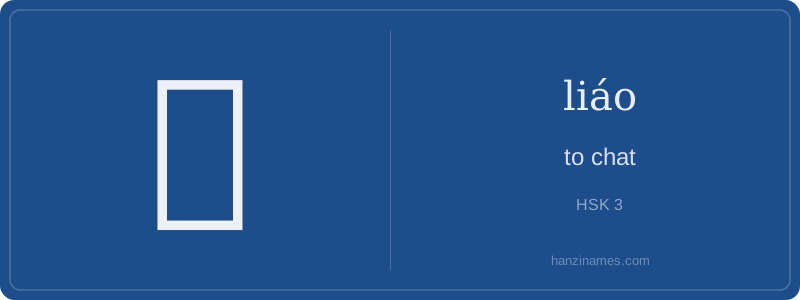
聊 is ubiquitous in modern Mandarin: used in digital messaging (e.g., ‘我们聊会儿?’), workplace small talk, and family gatherings. It appears in the common phrase 聊天 (liáotiān, 'to chat'), which entered vernacular use by the Ming-Qing period and is now standard across all HSK levels. A documented idiom is ‘百无聊赖’ (bǎi wú liáo lài)—‘utterly listless,’ attested in Qing dynasty literature—highlighting 聊’s semantic link to alleviating emptiness through dialogue.
The character is a phono-semantic compound: left radical 耳 (ear, indicating auditory context) + right phonetic component 卯 (mǎo, archaic pronunciation influence). While 卯 no longer matches modern liáo, historical phonology shows Middle Chinese *ljɛu*, confirming its phonetic role. No oracle-bone or bronze inscriptions exist for 聊—it first appears in Han-era bamboo slips as a colloquial verb meaning ‘to pass time in talk.’
The character 聊 (liáo) embodies the Chinese cultural reverence for relational harmony and gentle connection. Unlike Western notions of 'chat' that may emphasize information exchange or efficiency, 聊 connotes unhurried, low-stakes conversation—often over tea, during idle moments, or as a form of emotional maintenance. It reflects the Confucian ideal of *ren* (benevolence) expressed through attentive listening and warm presence, not just words.
Its radical 耳 (ear) signals that true 聊 is rooted in listening—not speaking. In traditional Chinese thought, the ear precedes the mouth in moral cultivation: one must first receive before responding. This prioritizes receptivity, humility, and empathy—making 聊 an act of quiet respect rather than self-expression. The character thus encodes a worldview where relationship-building is embodied, auditory, and non-instrumental.
Historically, 聊 appears early in classical texts like the *Book of Songs* (Shījīng), often in phrases like ‘聊以卒岁’ (liáo yǐ zú suì)—‘merely to get through the year’—suggesting its original nuance of ‘passing time’ or ‘making do.’ Over centuries, this softened into today’s friendly, unpressured chatting—mirroring how Chinese society values continuity, adaptability, and lightness in human interaction.
Example Sentences
Common Compounds
Similar Characters — Don't Mix These Up
Your First Step into Chinese Culture: Get a Chinese Name
Every journey into Chinese begins with a name. Use our free Chinese name generator to create a meaningful, personalized Chinese name that fits you perfectly.
Get My Chinese Name →