腿
Character Story & Explanation
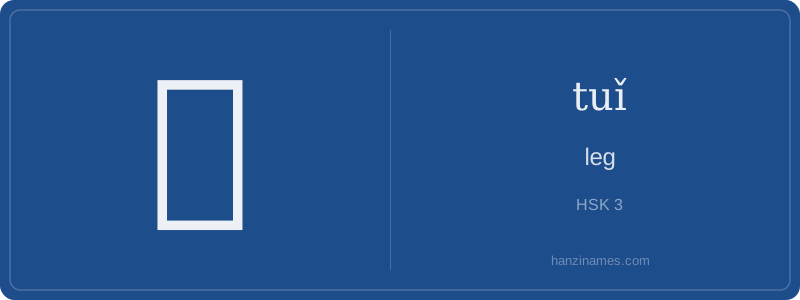
腿 is ubiquitous in modern Mandarin: used medically (e.g., 腿疼 'leg pain'), athletically ('stretch your legs'), and idiomatically — notably in the common phrase 拖后腿 (tuō hòu tuǐ), meaning 'to hold someone back', literally 'drag the rear leg', first attested in early 20th-century political writings as a metaphor for obstructionism. It also appears in classical-influenced expressions like 三寸金莲 (sān cùn jīn lián, 'three-inch golden lotus'), referencing bound feet — where 腿 implicitly contrasts with the foot.
The character’s form has no verified pictographic origin. Unlike ancient characters, 腿 lacks oracle-bone or bronze inscriptions. Instead, its structure is purely phono-semantic: ⺼ (body/flesh) + 退 (phonetic, originally meaning 'to retreat'). Today, Chinese speakers most commonly use it in health contexts — 'my leg hurts', 'leg cramp', or 'leg day' (a loan translation widely understood in gyms).
As a linguistic detective, I begin at the scene: the character 腿 (tuǐ) — 'leg' — first appears in standard clerical script during the Han dynasty (206 BCE–220 CE), not earlier oracle bones or bronze inscriptions. Its radical ⺼ (the 'flesh' or 'body' component) immediately signals corporeal meaning, anchoring it to anatomy. The right side, 退 (tuì, 'to retreat'), serves phonetically — though pronunciation has shifted slightly from Middle Chinese *thwajX to modern tuǐ — a classic example of phono-semantic compounding.
This character doesn’t depict a leg pictorially — unlike early characters such as 人 (rén, 'person') or 目 (mù, 'eye'). Instead, it’s a later, abstract construction born from functional needs: distinguishing limbs in medical, martial, and daily contexts. By the Tang dynasty, 腿 was standard in texts describing acupuncture points and martial postures, confirming its lexical stabilization well before the Song printing boom.
Crucially, 腿 replaced older, more general terms like 肢 (zhī, 'limb') when specificity mattered — especially for lower limbs. Its rise correlates with increased documentation of physical labor, dance, and military training, where precise terminology for movement and injury became essential. No mythical origin story survives; rather, its evolution reflects pragmatic language development — a quiet triumph of semantic clarity over poetic symbolism.
Example Sentences
Common Compounds
Similar Characters — Don't Mix These Up
Your First Step into Chinese Culture: Get a Chinese Name
Every journey into Chinese begins with a name. Use our free Chinese name generator to create a meaningful, personalized Chinese name that fits you perfectly.
Get My Chinese Name →