般
Character Story & Explanation
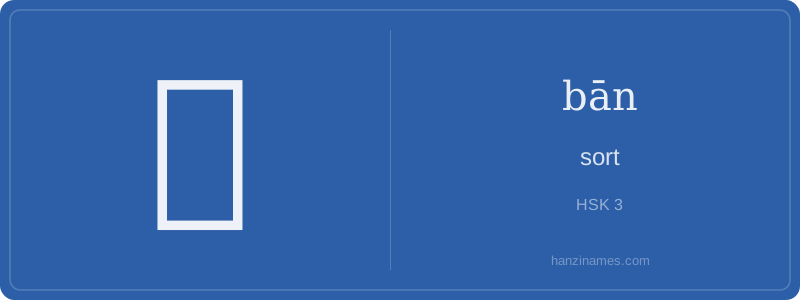
In modern Mandarin, 般 is almost exclusively used in fixed expressions denoting kind, type, or similarity—especially in written and formal speech. It appears in HSK-3 vocabulary like ‘一般’ (yībān, 'general/ordinary'), ‘这般’ (zhèbān, 'this kind of'), and the literary construction ‘…般…’ (e.g., ‘火般红’, huǒ bān hóng, 'as red as fire'). It’s rare in isolation and never used colloquially as a standalone noun meaning 'sort'; instead, it’s bound within compounds or comparative structures.
The character’s form has no verified pictographic origin—it does not depict a boat in motion, nor any object. Unlike clear pictographs (e.g., 日 for 'sun'), 般 emerged as a phono-semantic compound during the Warring States period. Today, Chinese learners encounter it most often in classroom drills for ‘一般’ and exam idioms like ‘一见如故,相见恨晚,般般皆到’—though the last is archaic. Its real-life utility lies in reading comprehension and formal writing, not daily conversation.
Our detective begins at the crime scene: the character 般. At first glance, it appears to be a simple 'boat' (舟) with a mysterious 'ban' component (殳) added—yet no ancient boat ever carried a spear-hand (殳) as cargo. Early inscriptions show no pictorial link to vessels in motion; instead, scholars trace 般’s earliest secure attestation to Warring States bamboo slips, where it functions phonetically and semantically as a classifier for kinds or types—already detached from literal nautical meaning.
The radical 舟 (boat) is misleading: it’s not semantic but phonetic residue. In Old Chinese, 般 (*praːn) and 舟 (*tju) shared consonantal roots, making 舟 a convenient sound hint—not a meaning clue. The '殳' (shū, a hand-held weapon/striking tool) is equally deceptive: it’s a phonetic marker from related words like 殷 (yīn), not a gesture of force. This is linguistic camouflage: a character built for sound, then repurposed for abstraction.
By the Han dynasty, 般 had fully evolved into a grammatical particle meaning 'sort', 'kind', or 'such'. Its use in classical texts like the *Zuo Zhuan* and *Huainanzi* shows consistent function—not as a noun, but as a modifier indicating category or resemblance. Modern usage retains this core: it never stands alone as a noun ('a sort') but always modifies or compares ('this sort of', 'just like'). The boat? Just an echo—like finding a sailcloth label on a filing cabinet.
Example Sentences
Common Compounds
Similar Characters — Don't Mix These Up
Your First Step into Chinese Culture: Get a Chinese Name
Every journey into Chinese begins with a name. Use our free Chinese name generator to create a meaningful, personalized Chinese name that fits you perfectly.
Get My Chinese Name →