草
Character Story & Explanation
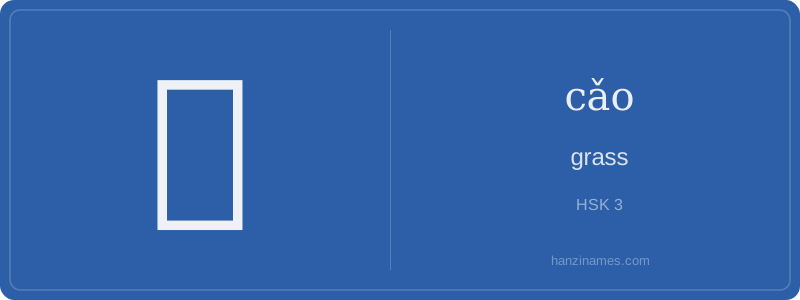
草 is ubiquitous in daily Chinese: from weather reports ('grass-covered hills turn green in spring') to idioms like 草木皆兵 (cǎo mù jiē bīng, 'every bush and tree looks like an enemy soldier' — describing extreme paranoia, from the 4th-century Battle of Fei River). It appears in place names (Grassland Province, 内蒙古草原), herbal medicine (中草药, zhōngcǎoyào), and internet slang (e.g., 草!as a censored exclamation akin to 'damn!', borrowing its homophone for 'rough' or 'casual').
The character’s form is documented as a semantic-phonetic compound since the Qin seal script era — not a pictograph. Its top is the standardized grass radical 艹; bottom is 早, chosen for sound. No verified oracle-bone version of 草 exists; earliest attestation is in Warring States bamboo slips and Han dynasty texts, consistently using this structure.
Our detective begins at the crime scene: the earliest known form of 草 appears in seal script (c. 3rd century BCE), where it clearly combines the radical 艹 (grass/plant) atop the phonetic component 早 (zǎo, 'early') — not as a pictograph of grass blades, but as a semantic-phonetic compound. This structure reveals ancient Chinese lexicography’s logic: categorize by meaning (plants), borrow sound from another character.
Zooming in on the radical 艹: it evolved from two stylized sprouts — originally written as two horizontal strokes over a vertical line in oracle bone and bronze inscriptions. By the Han dynasty, it standardized into the modern 'grass head', appearing atop over 1,200 plant-related characters. Its consistent placement signals botanical semantics, making it one of Chinese writing’s most reliable meaning clues.
Why 早 as the phonetic? Though modern cǎo and zǎo differ in tone, Old Chinese reconstructions (e.g., *tsʰuʔ) show close phonetic kinship. This isn’t coincidence — it’s linguistic forensics. The character didn’t grow from a grass drawing; it was engineered: 'plant' + 'early-sounding element'. Every stroke serves function — no decorative flourishes, only semantic precision and phonetic utility.
Example Sentences
Common Compounds
Similar Characters — Don't Mix These Up
Your First Step into Chinese Culture: Get a Chinese Name
Every journey into Chinese begins with a name. Use our free Chinese name generator to create a meaningful, personalized Chinese name that fits you perfectly.
Get My Chinese Name →