万
Character Story & Explanation
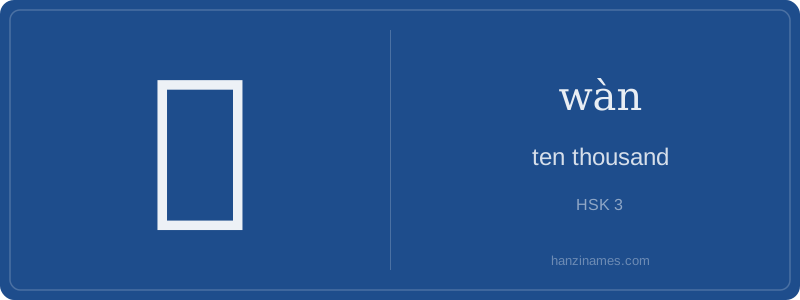
万 is ubiquitous in modern Chinese: used in finance (e.g., salaries quoted in 'tens of thousands of yuan'), population statistics (e.g., '200,000 people' = 二十万人 èr shí wàn rén), and idioms like 万无一失 (wàn wú yī shī, 'foolproof' — literally 'ten thousand without one loss'). Historically, it appears in classical texts like the Dao De Jing ('All things under heaven arise from existence; existence arises from non-existence' — 万物生于有,有生于无), where 万 emphasizes totality.
The earliest confirmed form of 万 appears in bronze inscriptions of the Western Zhou dynasty (c. 1046–771 BCE) as a simplified variant of 萬, originally pictographic of a scorpion — later borrowed phonetically for 'ten thousand'. Today, the simplified 万 (introduced in 1956) is universal in mainland China, used daily by over a billion people — on price tags, apps, subway maps, and weather reports.
Hello students! The character 万 (wàn) means 'ten thousand' — but don’t think of it only as a number. In Chinese, it’s often used to express vastness, abundance, or exaggeration — like saying 'a million things' in English. It’s simple: just three strokes, starting with a horizontal line (一), then a left-falling stroke (丿), and finally a rising dot-like stroke (㇏). Though small, it carries big weight in both math and metaphor!
As an HSK Level 3 character, 万 appears frequently in daily language — from prices ('10,000 yuan') to idioms ('all kinds of things'). It’s not used alone as a standalone word very often; instead, it combines with other characters to form numbers (e.g., 万一 wàn yī 'just in case') or abstract concepts (e.g., 万物 wàn wù 'all things in the universe'). Pay attention to its tone: wàn is fourth tone — sharp and falling.
Because it’s so common, mastering 万 helps you read signs, news headlines, and even social media posts. You’ll see it in expressions like 万人空巷 (wàn rén kōng xiàng, 'so many people that streets are empty') — describing huge crowds. Remember: it’s not about counting exactly 10,000 — it’s about scale, intensity, and cultural resonance. Practice writing it slowly, following stroke order, and say it aloud with confidence: wàn!
Example Sentences
Common Compounds
Similar Characters — Don't Mix These Up
Your First Step into Chinese Culture: Get a Chinese Name
Every journey into Chinese begins with a name. Use our free Chinese name generator to create a meaningful, personalized Chinese name that fits you perfectly.
Get My Chinese Name →