解
Character Story & Explanation
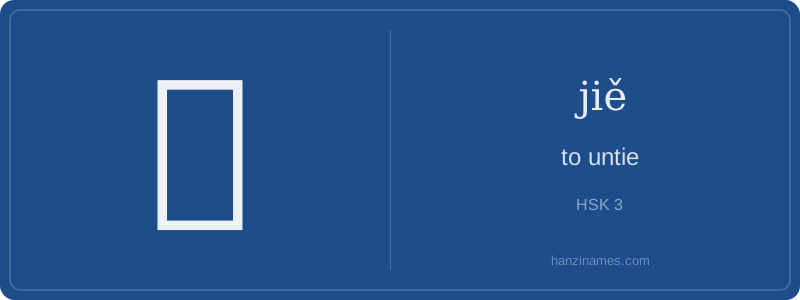
解 appears in foundational texts like the Classic of Rites (Lǐjì, c. 3rd century BCE), where 解 is used for ‘resolving ritual doubts’ and ‘dissolving seasonal obstructions’. Today, it’s ubiquitous: students say ‘这道题我解出来了’ (zhè dào tí wǒ jiě chū lái le) — ‘I solved this math problem’; doctors use 解毒 (jiědú, ‘detoxify’); and media headlines read ‘专家解读政策’ (zhuānjiā jiědú zhèngcè, ‘experts explain the policy’). The idiom 迎刃而解 (yíng rèn ér jiě, ‘to resolve effortlessly, like a knife parting bamboo’) dates to the 3rd-century Records of the Three Kingdoms.
The character evolved from seal script (c. 200 BCE), where its left side clearly shows 角 (‘horn’), symbolizing sharpness and discernment, while the right side 奐 originally depicted two hands exchanging or dispersing something—reflecting its core meanings of separation, release, and clarification.
解 (jiě) is more than a verb—it’s a philosophical lens into the Chinese worldview, where understanding is inseparable from release and transformation. To ‘explain’ is not merely to state facts, but to untangle confusion like loosening a knot; to ‘dissolve’ is not destruction, but harmonious dispersion—like salt in water. This triadic meaning reflects the classical ideal of balance: clarity emerges only when constraints are gently undone.
The character’s radical 角 (jiǎo, ‘horn’) hints at ancient associations with ritual, sacrifice, and boundary-setting—yet 解 subverts rigidity by introducing fluidity. Its phonetic component 奐 (huàn, now obsolete as an independent character) once conveyed ‘change’ or ‘exchange’, reinforcing that true explanation requires perspective-shifting, not static definitions.
In Daoist and Confucian thought, 解 embodies wu wei–effortless action: resolving conflict without force, clarifying ideas without dogma. Even in modern Mandarin, saying ‘我解了’ (wǒ jiě le) means ‘I get it’—not just cognitively, but existentially, as if a mental knot has dissolved. This holistic resonance makes 解 a quiet anchor in China’s linguistic ecology: knowledge as liberation, insight as unbinding.
Example Sentences
Common Compounds
Similar Characters — Don't Mix These Up
Your First Step into Chinese Culture: Get a Chinese Name
Every journey into Chinese begins with a name. Use our free Chinese name generator to create a meaningful, personalized Chinese name that fits you perfectly.
Get My Chinese Name →