词
Character Story & Explanation
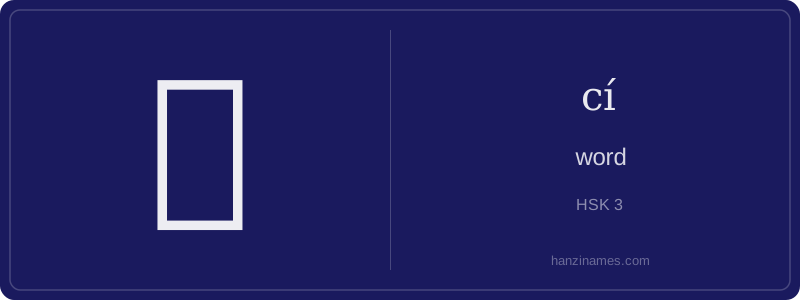
In modern Chinese, 词 appears ubiquitously: in HSK vocabulary lists (HSK 3), dictionary headers (《现代汉语词典》), and digital interfaces (e.g., '搜索词'—search term). It's central to phrases like '关键词' (key word), '同义词' (synonym), and the idiom '词不达意' (words fail to convey meaning)—documented since the Ming dynasty in rhetorical treatises. Linguists confirm its consistent use since the Han for lexical units, especially in contrast to 语 (yǔ), which emphasizes speech acts or language systems.
The character’s form is a documented phono-semantic compound: 讠 (speech radical) + 司 (sī, phonetic and semantic hint—'to manage', implying regulated speech). No oracle-bone or bronze inscriptions contain 词; it first appears in Han-era bamboo slips as a standardized character for 'lexical item'. Today, students write it daily in vocabulary notebooks—seven strokes practiced with emphasis on the clean hook of the final stroke in 司.
As an archaeologist brushing dust from a Tang-dynasty stele, I uncover 词 not as a mere 'word' but as a lexical artifact—carved with the radical 讠 (speech) and the phonetic component 司 (sī), signaling both sound and function. Its seven strokes form a compact vessel for linguistic meaning: not just vocabulary, but structured expression—poetic lines, legal terms, or bureaucratic documents all relied on this unit of semantic precision.
This character emerged fully in clerical script during the Han dynasty, replacing earlier variants like 辭. Unlike pictographic ancestors, 词 is a phono-semantic compound—its form reveals how ancient scribes prioritized *audible function* over visual metaphor. The left side 讠 anchors it to spoken language; the right 司 implies administration, judgment, and ritual utterance—suggesting words were never neutral, but instruments of authority and artistry.
In Song dynasty poetry, 词 evolved into a distinct literary genre—the *ci* lyric, set to music and bound by tonal patterns. Here, 词 transcends ‘word’ to mean ‘a measured utterance’, where each character’s tone and placement carried emotional weight. To excavate 词 is to find a linguistic fossil that preserved both grammar and grace—proof that in Chinese writing, meaning is always entombed with rhythm, context, and power.
Example Sentences
Common Compounds
Similar Characters — Don't Mix These Up
Your First Step into Chinese Culture: Get a Chinese Name
Every journey into Chinese begins with a name. Use our free Chinese name generator to create a meaningful, personalized Chinese name that fits you perfectly.
Get My Chinese Name →