议
Character Story & Explanation
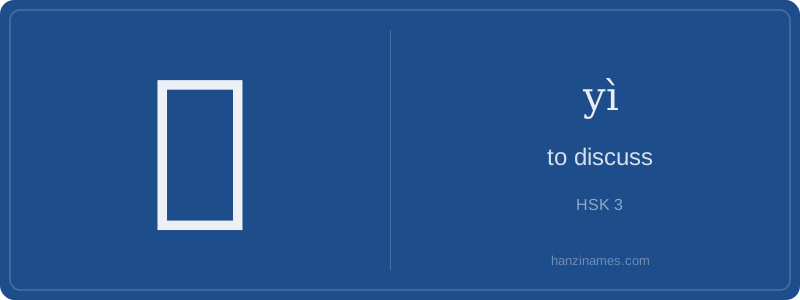
In modern China, 议 appears daily in formal and civic contexts: government bulletins use 议案 (yì’àn, 'bill' or 'proposal') for legislative drafts; students learn 议论文 (yìlùnwén, 'argumentative essay') as a core HSK 3–4 writing genre requiring evidence-based commentary. A well-documented phrase is ‘有议必复’ (yǒu yì bì fù)—a 20th-century administrative principle meaning ‘every proposal must receive a reply’, reflecting institutional accountability.
Historically, 议 evolved from seal script (c. 3rd century BCE), where its right side 义 already signified moral appropriateness. The left side 讠 (a simplified form of 言) consistently marked speech-related characters. No oracle-bone origin exists for 议—it first appears in standardized Qin dynasty script as a compound meaning ‘to deliberate with righteous intent’.
The character 议 (yì) embodies a foundational Chinese cultural value: the belief that thoughtful speech is not merely expression, but civic responsibility. With its ‘speech’ radical (讠) and right-side component 义 (yì, 'righteousness' or 'justice'), it visually fuses language with moral duty—commenting isn’t casual opinion, but ethically grounded discourse. This reflects Confucian ideals where words must align with virtue and social harmony.
In traditional governance, 议 was central to imperial deliberation—scholars ‘discussed policy’ (议政 yìzhèng) in court assemblies, ensuring decisions emerged from collective, principled dialogue rather than unilateral decree. Even today, the term 议会 (yìhuì, 'parliament') carries this legacy: institutions designed not for debate-as-competition, but for reasoned consultation toward the common good.
Unlike Western notions of free speech as individual assertion, 议 emphasizes speech as relational and purposeful—measured, constructive, and oriented toward resolution. The minimal five strokes belie its weight: each stroke is a reminder that how we speak shapes how society thinks, governs, and endures. To 议 is to participate—not just voice, but contribute wisely.
Example Sentences
Common Compounds
Similar Characters — Don't Mix These Up
Your First Step into Chinese Culture: Get a Chinese Name
Every journey into Chinese begins with a name. Use our free Chinese name generator to create a meaningful, personalized Chinese name that fits you perfectly.
Get My Chinese Name →