护
Character Story & Explanation
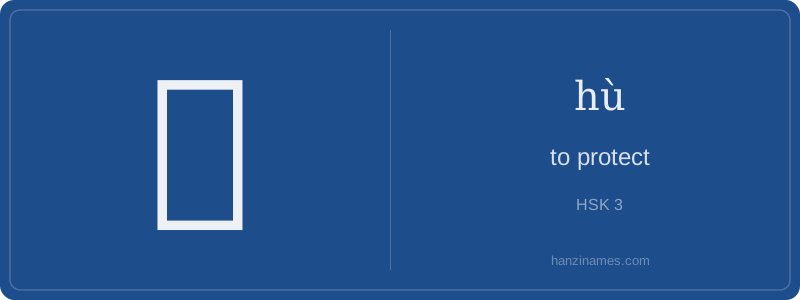
护 is ubiquitous in modern Chinese: from hospital signs reading ‘重症监护室’ (ICU—Intensive Care Unit) to national campaigns like ‘护苗行动’ (‘Protect the Seedlings’ campaign against online harm to minors), launched by China’s Cyberspace Administration in 2021. It appears in HSK-3 vocabulary lists as a core verb for expressing active safeguarding—e.g., 护理 (hùlǐ, nursing), 护照 (hùzhào, passport—literally ‘protection document’), and the idiom 爱护 (àihù, ‘to cherish and protect’), used in education policy and parenting guides.
The character’s form is not pictographic but phono-semantic: left radical 扌 (hand action) + right phonetic component 户 (hù, meaning ‘household’ or ‘door’—also providing sound). First attested in clerical script on Han dynasty bamboo slips (c. 206 BCE–220 CE), it shows no oracle bone or bronze variant—its earliest secure form is already semantic compound, not a picture.
As an archaeologist brushing dust from a Han dynasty bamboo slip, I find 护 etched not as a divine mandate—but as a practical, urgent gesture: the hand (扌) actively shielding something vital. Its seven strokes encode urgency—no ornamental flourishes, just economy and intent. This isn’t passive guardianship; it’s intervention: a soldier raising a shield, a parent pulling a child from traffic, a scribe preserving fragile texts. The character emerged when imperial archives needed protection—and so did families, borders, and sacred rites.
Excavations at Mawangdui revealed medical manuscripts labeled ‘护气’ (hù qì)—‘protecting vital energy’—showing 护 was already embedded in early Chinese medicine by 2nd c. BCE. Unlike abstract virtues like 仁 (benevolence), 护 is tactile and time-bound: it implies threat, response, and consequence. Its radical 扌 confirms embodiment—the protection happens *through the body*, not prayer alone. Even in bronze inscriptions, variants show a hand gripping a barrier, not blessing from afar.
The character’s endurance reveals cultural priority: societies that codified ‘protection’ before ‘freedom’ or ‘justice’ placed survival—and responsibility—at the core. In Tang legal codes, ‘护’ appears in statutes punishing officials who failed to 护境 (hù jìng, protect borders) or 护民 (hù mín, protect the people). It’s a duty verb—not optional morality, but enforceable obligation. That weight still echoes: today’s ‘网络安全防护’ (cybersecurity protection) inherits the same grammatical gravity discovered in those ancient slips.
Example Sentences
Common Compounds
Similar Characters — Don't Mix These Up
Your First Step into Chinese Culture: Get a Chinese Name
Every journey into Chinese begins with a name. Use our free Chinese name generator to create a meaningful, personalized Chinese name that fits you perfectly.
Get My Chinese Name →