银
Character Story & Explanation
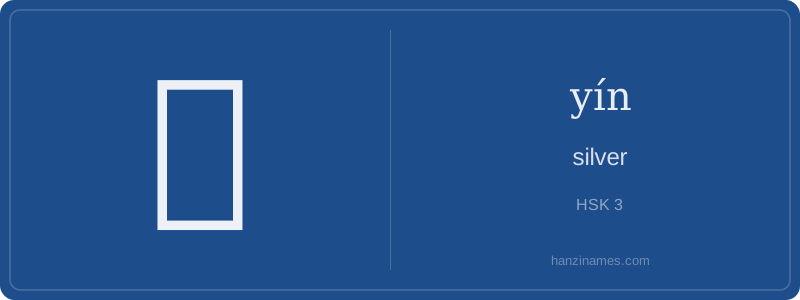
银 has been a cornerstone of Chinese finance for over 500 years: the Ming dynasty (1368–1644) officially adopted silver as the primary medium for tax payments and large-scale trade, leading to massive inflows of Spanish-American silver via Manila galleons. Today, 银 appears ubiquitously—in bank names (中国银行 Zhōngguó Yínháng), digital payment terms (银联 Yínlián, China UnionPay), and idioms like 真金不怕火炼, though 银 itself isn’t in that phrase, it’s central to financial vocabulary. It’s also used in medical contexts (e.g., 硝酸银 xīsuān yín, 'silver nitrate') and jewelry descriptions.
The character evolved from the ancient form 銀, where the left side 钅 is the simplified metal radical (introduced in 1956 PRC script reform), and the right side 艮 (gèn) serves phonetically. No pictographic origin survives—unlike 日 (sun) or 木 (tree)—but its structure reflects the standard semantic-phonetic compound design common in ~90% of modern Chinese characters.
The Chinese character 银 (yín) means 'silver'—a precious metal with deep economic, cultural, and symbolic significance in China. Unlike gold (金), which traditionally symbolized imperial authority and permanence, silver historically functioned as the backbone of China’s monetary system from the Ming dynasty onward, especially after the adoption of the silver standard in the 16th century. Its use in coinage, trade, and taxation made it central to everyday commerce and state finance.
Western equivalents like 'silver' in English carry similar connotations of value and purity, but culturally, silver in China also evokes refinement and modest elegance—seen in traditional silver hairpins, wedding ornaments, and medicinal uses (e.g., colloidal silver in folk remedies). In contrast, Western silver symbolism often leans toward mysticism (e.g., werewolf lore) or modern tech (conductive wiring), whereas Chinese usage remains more grounded in material economy and aesthetic tradition.
HSK Level 3 places 银 within intermediate learners’ scope—not just for vocabulary, but because it appears in high-frequency compounds like 银行 (yínháng, 'bank') and 银色 (yínsè, 'silvery color'). Its radical 钅 (metal) signals lexical kinship with other metals (e.g., 铁 tiě 'iron', 铜 tóng 'copper'), helping learners decode meaning and pronunciation patterns systematically.
Example Sentences
Common Compounds
Similar Characters — Don't Mix These Up
Your First Step into Chinese Culture: Get a Chinese Name
Every journey into Chinese begins with a name. Use our free Chinese name generator to create a meaningful, personalized Chinese name that fits you perfectly.
Get My Chinese Name →