锻
Character Story & Explanation
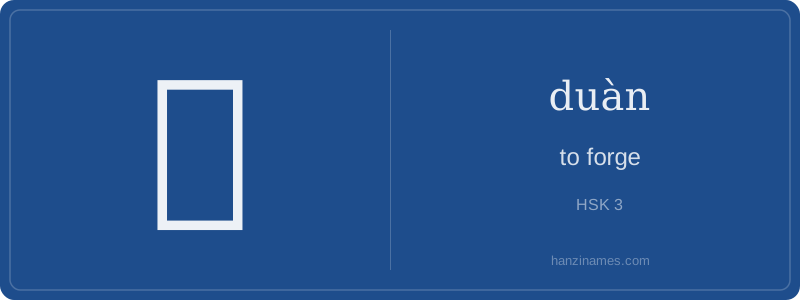
锻 is widely used in modern Chinese for physical and mental training—most commonly in the compound 锻炼 (duànliàn), meaning 'to exercise' or 'to train'. It appears in official slogans (e.g., '加强身体锻炼' — 'Strengthen physical exercise'), school curricula, and fitness apps. Historically, it appears in Song- and Ming-dynasty texts describing weapon-making; the 11th-century *Wujing Zongyao* (Compendium of Military Classics) references 锻铁 ('forging iron') for armor production.
The character evolved from seal script, where 钅 (metal) clearly represents the material context, and 段 originally meant 'a section' or 'segment'—reflecting the repeated heating-and-hammering cycles in forging. No oracle-bone form survives, but its structure has remained stable since the Han dynasty, confirming its longstanding association with controlled, sequential refinement.
The Chinese character 锻 (duàn) literally means 'to forge'—referring to the physical process of heating and hammering metal to shape or strengthen it. In modern usage, it extends metaphorically to 'tempering' or 'cultivating' qualities like willpower, skills, or character through rigorous practice or adversity. This dual meaning reflects a core Confucian and Daoist value: growth arises not from ease, but from disciplined refinement.
Unlike English 'forge', which primarily denotes creation (e.g., forging alliances), 锻 emphasizes *transformation through effort*—especially internal development. It appears in contexts ranging from blacksmithing to martial arts training and leadership education. Its radical 钅 (metal) anchors it firmly in material craft, while the right component 段 (duàn) suggests segmentation, layering, or stages—hinting at the stepwise, iterative nature of forging.
In Western metallurgical tradition, forging evokes images of medieval smiths shaping swords—a symbol of craftsmanship and strength. Similarly, 锻 carries heroic connotations in Chinese history, linked to legendary weapons like the Sword of Goujian and elite military training. Yet culturally, 锻 is more frequently used today in abstract, self-cultivation contexts—e.g., 锻炼 (duànliàn, 'to train')—making it a linguistic bridge between ancient craft and contemporary personal development philosophy.
Example Sentences
Common Compounds
Similar Characters — Don't Mix These Up
Your First Step into Chinese Culture: Get a Chinese Name
Every journey into Chinese begins with a name. Use our free Chinese name generator to create a meaningful, personalized Chinese name that fits you perfectly.
Get My Chinese Name →