需
Character Story & Explanation
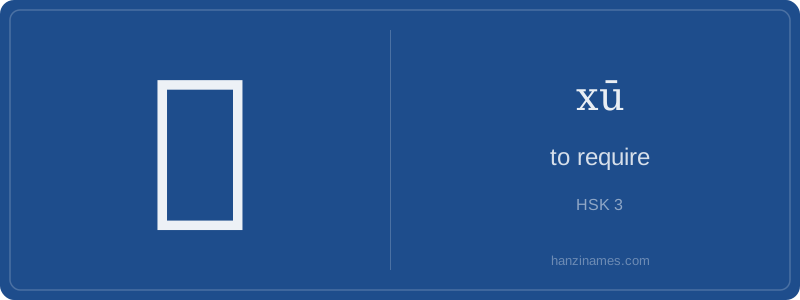
需 appears in foundational classical texts like the I Ching (Yìjīng), where it’s the name of Hexagram 5 (‘Waiting’ or ‘Nourishment’), symbolizing patience amid necessity — historically tied to waiting for timely rain, hence its 雨 radical. Today, it’s indispensable in modern Chinese: government reports cite '社会需求' (social demand), hospitals post '需预约' (appointment required), and job ads list '需三年经验' (three years’ experience required). The phrase '按需分配' (ànxū fēnpèi, 'distribution according to need') is a key socialist principle in official discourse.
The character’s form dates to the Warring States period (475–221 BCE) and evolved from bronze inscriptions. Its top is clearly 雨 (rain), while the bottom 而 was standardized early as a phonetic marker — not a pictograph of a beard in later usage, but a consistent sound cue. No oracle bone form survives, but seal script confirms this structure was stable by the Qin dynasty.
Hi students! Let’s look at the character 需 (xū), meaning 'to require' or 'to need'. It’s an HSK Level 3 character — very common in daily speech and writing. Notice its radical 雨 (yǔ), meaning 'rain', placed at the top — this tells us it’s related to weather or atmospheric phenomena *in origin*, though today its meaning is purely abstract: necessity. Don’t worry — you won’t use it to talk about rain! Think of it as a formal, slightly literary way to express need, often in written contexts like signs, official notices, or news.
The bottom part is 而 (ér), which originally meant 'beard' but now serves mainly as a phonetic component (giving the 'xū' sound). This is a classic example of a phono-semantic compound: one part hints at meaning (雨 — historically linked to ritual rain prayers implying *urgency* or *necessity*), the other at pronunciation. Though the connection isn’t obvious today, recognizing radicals helps you group characters and guess meanings.
In spoken Mandarin, you’ll often hear 需 (xū) in compound words rather than alone — like 需要 (xūyào, 'to need') or 需求 (xūqiú, 'demand'). It’s rarely used solo in conversation (unlike 要 yào), but appears frequently in formal speech, academic texts, policy documents, and even on public signs — for example, '本区域需持证进入' ('This area requires a permit to enter'). Mastering 需 helps you read real-world Chinese with confidence!
Example Sentences
Common Compounds
Similar Characters — Don't Mix These Up
Your First Step into Chinese Culture: Get a Chinese Name
Every journey into Chinese begins with a name. Use our free Chinese name generator to create a meaningful, personalized Chinese name that fits you perfectly.
Get My Chinese Name →