静
Character Story & Explanation
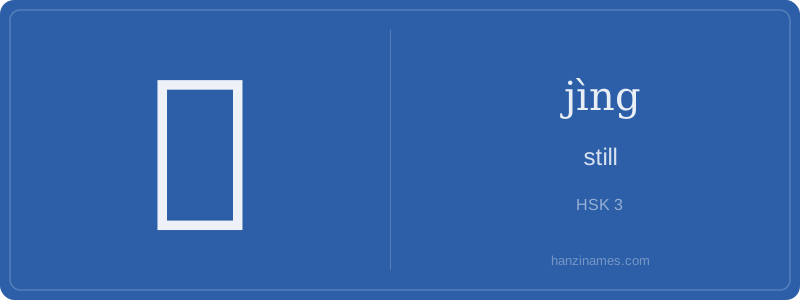
静 is ubiquitous in daily Chinese life: used in public announcements (‘请保持安静’—‘Please keep quiet’), meditation apps (静心模式, ‘calm-mind mode’), and classroom management (‘教室要安静’—‘The classroom must be quiet’). It appears in foundational idioms like 平静如水 (píngjìng rú shuǐ, ‘calm as water’) and the famous Confucian phrase ‘知者乐水,仁者静’ (‘The wise delight in water; the humane are still’), recorded in the *Analects* (12.20).
The character’s form dates to the Warring States period (475–221 BCE) and evolved from seal script. Its left side 青 (qīng, ‘blue-green’) originally denoted the color of clear, deep water or young plants—symbolizing freshness and purity—while the right side 争 (zhēng, ‘to contend’) was later simplified to 竞 (jìng) and then to 青 + 争’s phonetic component. Modern orthography standardizes it as 青 + 争, with no pictographic sun/moon/tree origin—its meaning emerged through semantic-phonetic construction, not visual depiction.
静 (jìng) embodies a profound Chinese philosophical ideal—not mere physical stillness, but the inner calm that arises from harmony with nature and self-restraint. Rooted in Daoist and Confucian thought, it reflects the belief that true power lies not in action, but in poised awareness: the quiet lake reflecting the sky, the sage who speaks only when necessary. This stillness is active, not passive—a cultivated state of clarity and readiness.
In traditional Chinese medicine and martial arts, 静 is essential to qi regulation; one must first settle the mind (心静) to circulate vital energy smoothly. The character appears in classical texts like the *Tao Te Ching*, where 'stillness conquers agitation' (清静为天下正) underscores its moral and cosmological weight. It signifies equilibrium—between yin and yang, movement and rest, speech and silence.
This worldview rejects binary oppositions: stillness isn’t the absence of motion but its conscious containment. A calligrapher pauses before the brushstroke; a Zen gardener rakes gravel into waves—both enact 静 as disciplined presence. In modern life, it’s invoked in mindfulness practices, workplace wellness programs, and even urban planning (e.g., ‘quiet zones’ in Shanghai parks), revealing how an ancient concept continues to shape contemporary Chinese values of balance, reflection, and respectful coexistence.
Example Sentences
Common Compounds
Similar Characters — Don't Mix These Up
Your First Step into Chinese Culture: Get a Chinese Name
Every journey into Chinese begins with a name. Use our free Chinese name generator to create a meaningful, personalized Chinese name that fits you perfectly.
Get My Chinese Name →