须
Character Story & Explanation
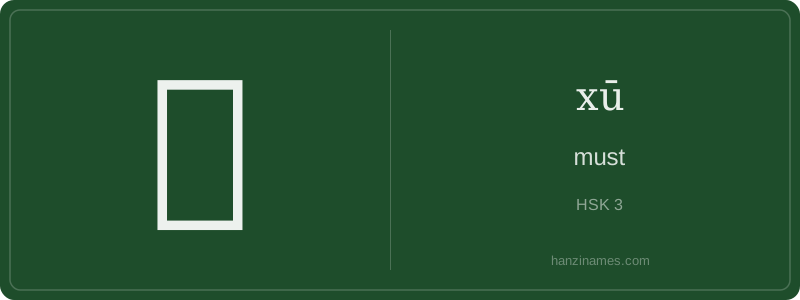
In modern Chinese, 须 is a high-register modal verb meaning ‘must’ or ‘shall’, used predominantly in formal writing, regulations, academic instructions, and news reports—not casual speech. It appears in standardized phrases like ‘须经批准’ (xū jīng pīzhǔn, ‘must be approved’) and the classical idiom ‘须臾不可离’ (xūyú bùkě lí, ‘cannot be parted with for even a moment’), cited in *The Book of Rites* and still quoted in education policy documents.
The character’s form originates as a pictograph of facial hair: early seal script (c. 220 BCE) clearly shows three curved 彡 strokes beside a head-like 页 component. Archaeological evidence confirms this depiction in Qin bamboo slips and Han dynasty dictionaries like *Shuōwén Jiězì*, which explicitly defines 须 as ‘rén miàn máo yě’ (‘facial hair of a person’)—its semantic shift to ‘necessity’ evolved later through grammaticalization.
As a linguistic detective, I begin with the oracle bone and bronze inscriptions—but here’s the twist: 须 (xū) doesn’t appear in earliest forms as ‘must’. Instead, its earliest attested use (Zhou dynasty bronzes, c. 1000 BCE) depicts facial hair—specifically, the beard or whiskers drawn with three flowing strokes (the 彡 radical). That visual anchor—striking, stylized hair—was later repurposed phonetically and semantically to express necessity, likely because beards signaled maturity, authority, and thus *obligation* in ancient rites and governance.
The shift from ‘beard’ to ‘must’ reflects a classic Chinese semantic evolution: concrete bodily signifier → abstract social concept. By the Warring States period, 须 appears in texts like the *Zuo Zhuan* not as anatomy, but as modal necessity—‘what must be done’. Its phonetic component 页 (yè, ‘leaf’/‘page’, but historically ‘head’) reinforces the head-related origin, anchoring the character in human physiology before ascending to grammatical function.
This duality persists today: 须 retains traces of its origin in words like 髭须 (zīxū, ‘whiskers and beard’), yet dominates formal registers expressing irrevocable requirement—like legal clauses or academic guidelines. Unlike colloquial 必须 (bìxū), 须 alone carries bureaucratic weight and literary austerity. Its nine-stroke form—three 彡 strokes cascading rightward—still echoes the graceful sweep of facial hair, a silent glyphic echo beneath every ‘you must’ in official Chinese.
Example Sentences
Common Compounds
Similar Characters — Don't Mix These Up
Your First Step into Chinese Culture: Get a Chinese Name
Every journey into Chinese begins with a name. Use our free Chinese name generator to create a meaningful, personalized Chinese name that fits you perfectly.
Get My Chinese Name →