头
Character Story & Explanation
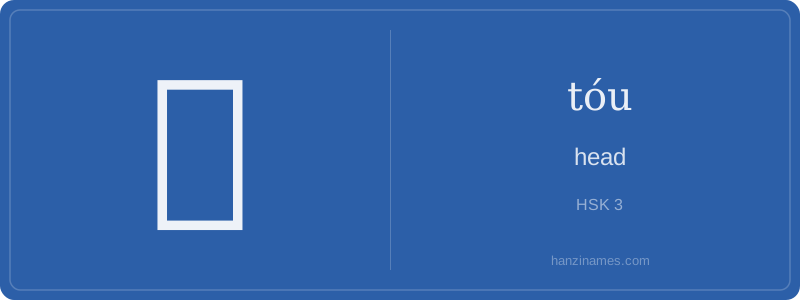
头 is ubiquitous in daily Mandarin: used literally (e.g., 洗头 xǐ tóu, 'to wash one’s hair'), metaphorically (e.g., 龙头 lóng tóu, 'dragon head' = industry leader), and idiomatically (e.g., 出头 chū tóu, 'to emerge into prominence'). It appears in HSK-3 vocabulary like 头发 (tóufa, 'hair') and 头疼 (tóuténg, 'headache'), and historically appears in Tang dynasty legal codes referring to 'head tax' (头税) on adult males. The idiom 摸着石头过河 (mō zhe shítou guò hé, 'cross the river by feeling for stones') uses 头 only in its compound 石头 (shítou, 'stone'), showing how productive the character is as a suffix.
头 is a simplified form of the ancient character 頭, which appeared in Han dynasty clerical script. Its modern shape evolved from a pictograph combining 大 (dà, 'big') and 丶 (a dot representing the top of the head). The radical 大 emphasizes the head’s prominence—visually and conceptually—as the largest, most expressive part of the upper body.
The character 头 (tóu) embodies more than anatomy—it reflects the Chinese worldview where the head is the seat of authority, wisdom, and social positioning. In classical thought, the head governs the body just as the ruler governs the state; Confucian texts repeatedly link ‘head’ with moral leadership and self-cultivation. This hierarchical symbolism extends to language: ‘head of household’ (户主, hùzhǔ) and ‘team leader’ (头儿, tóur) both use 头 to denote legitimate, respected authority—not mere physical location.
Unlike Western dualisms that separate mind from body, 头 integrates cognition, dignity, and relational role. To ‘lose face’ (丢脸, diū liǎn) often involves a visible lowering or turning away of the head—making 头 a silent barometer of honor and shame. Even in modern Mandarin, phrases like ‘head start’ (先头, xiāntóu) or ‘head of the line’ (排头, páitóu) preserve this spatial-moral logic: leading isn’t just temporal—it’s upright, visible, and socially sanctioned.
This holistic view surfaces in idioms like 摇头晃脑 (yáo tóu huàng nǎo)—‘shaking head and swaying body’—which doesn’t describe confusion but confident, rhythmic recitation of poetry or classics. The head moves not randomly, but in disciplined harmony with tradition. Thus, 头 is never merely biological: it’s a cultural node where physiology, ethics, and social order converge—quietly asserting that how one holds one’s head says everything about who one is.
Example Sentences
Common Compounds
Similar Characters — Don't Mix These Up
Your First Step into Chinese Culture: Get a Chinese Name
Every journey into Chinese begins with a name. Use our free Chinese name generator to create a meaningful, personalized Chinese name that fits you perfectly.
Get My Chinese Name →