关
Character Story & Explanation
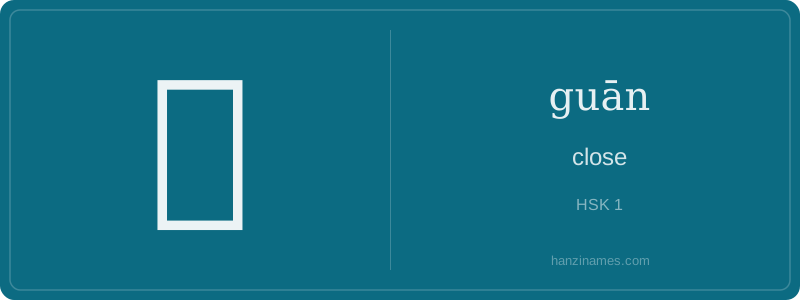
In modern China, 关 is ubiquitous: subway announcements say '车门即将关闭' (chēmén jíjiāng guānbì) — 'Doors are about to close'; smart-home apps display '关灯' (guān dēng) — 'Turn off the light'; and official documents begin with '关于进一步加强…的通知' (guānyú jìnyībù jiāqiáng… de tōngzhī) — 'Notice regarding further strengthening…'. The HSK 1 textbook lists 关 as foundational for verbs of control and relevance. A top-10 most frequently used verb in spoken Mandarin, it appears in idioms like '息息相关' (xī xī xiāng guān) — 'closely interrelated' — used in environmental reports and health bulletins.
The character’s earliest verified form appears on Western Zhou bronze vessels (1046–771 BCE) as a symmetrical gate motif — two downward strokes (丷) above a horizontal bar (一), representing double gate leaves closing. Though later stylized, this origin is confirmed by paleographers like Qiu Xigui in *Chinese Writing and Calligraphy* (2000). Its structure reflects controlled access — both literal and metaphorical — unchanged for over three millennia.
Imagine rushing through Beijing’s bustling Guomao subway station at 8:15 a.m. — the crowd surges, doors hiss open, then close with a soft *ding*. Just before you step in, a voice over the PA says, 'Please stand clear of the doors — they are about to guān.' That single syllable — 关 — pulses through daily life: closing elevator doors, locking apartment gates, shutting laptop lids, and even ending WeChat video calls with a tap on the '关' icon. It’s not just mechanical; it’s social rhythm.
But 关 also carries quiet weight beyond physics. When your Chinese friend says, '这跟您没关系' (zhè gēn nín méi guānxi), meaning 'This has nothing to do with you,' the character 关 appears in the compound 关系 (guānxi) — literally 'connection' or 'relationship'. Here, 关 implies involvement, relevance, or mutual accountability — a concept deeply woven into workplace etiquette, family obligations, and even government notices that begin with '关于…' (guānyú…), meaning 'regarding…' or 'concerning…'.
Historically, 关 was used on ancient bronze inscriptions (c. 1000 BCE) as a pictograph of two overlapping gates — symbolizing barrier, checkpoint, or control. Today, its dual nature remains intact: it shuts physical access (a door, a valve, a file) and opens conceptual awareness (a matter of concern, a shared responsibility). Whether toggling a light switch in Shanghai or reading a policy notice in Chengdu, 关 is one of the first verbs learners master — precisely because it anchors action, consequence, and connection in one compact, six-stroke form.
Example Sentences
Common Compounds
Similar Characters — Don't Mix These Up
Your First Step into Chinese Culture: Get a Chinese Name
Every journey into Chinese begins with a name. Use our free Chinese name generator to create a meaningful, personalized Chinese name that fits you perfectly.
Get My Chinese Name →