七
Character Story & Explanation
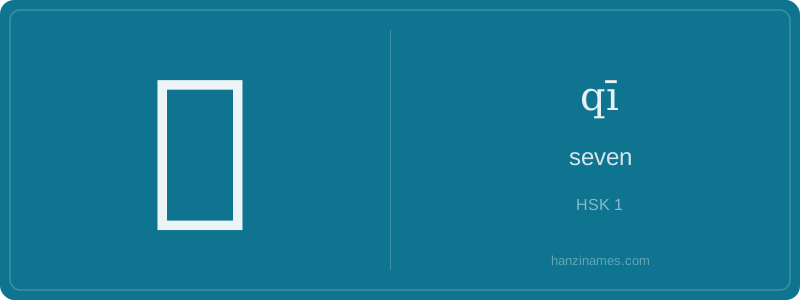
In everyday China, 七 appears constantly: metro line numbers (e.g., 上海地铁7号线), apartment floor indicators (7楼), and even food delivery apps showing ‘7 minutes away’. It’s central in common phrases like 七月 (qī yuè, ‘July’) and 七天 (qī tiān, ‘seven days’), and famously in the idiom 七上八下 (qī shàng bā xià), describing nervous agitation — literally ‘seven up, eight down’, referencing chaotic heartbeats. Historically, the character appears unchanged since the Shang dynasty oracle bones, where it was already a stylized numeral.
The earliest forms of 七 were pictographic representations of a crossbar over a vertical stroke — likely abstracted from tally marks. Unlike characters for ‘one’ (一) or ‘two’ (二), which are pure horizontal lines, 七’s second stroke is deliberately slanted, distinguishing it unambiguously in handwritten scripts. This deliberate diagonal ensures legibility across centuries of calligraphic variation.
The character 七 (qī) is one of the simplest yet most culturally resonant numerals in Chinese. With just two strokes — a horizontal line followed by a sweeping, slightly curved downward stroke — it embodies clarity and balance. Unlike more complex characters, 七 requires no internal structure or components, making it an early milestone for learners. Its clean form appears everywhere: on price tags in Shanghai markets, subway station signs in Beijing, and children’s counting books across China.
Despite its simplicity, 七 carries deep cultural weight. In traditional Chinese cosmology, seven represents completeness — seen in the ‘Seven Stars’ of the Big Dipper (北斗七星), revered for millennia in astronomy and Daoist ritual. The number also anchors key life rhythms: the seventh day after birth (‘seven-day celebration’), the seventh month (Ghost Month), and the seven days of the week, now standard in modern usage. This duality — minimal form, maximal meaning — makes 七 unforgettable.
For English speakers, 七 is often the first Chinese numeral mastered beyond ‘one’ and ‘two’. Its pronunciation qī features the high, flat first tone — like holding a steady musical note — and is consistently used in compound numbers (e.g., 七十 qīshí ‘seventy’). Because it’s HSK Level 1 and appears in foundational vocabulary (days of week, addresses, ages), mastering 七 opens doors to daily communication, from ordering food to reading train schedules — all while reinforcing core writing discipline through precise stroke order.
Example Sentences
Common Compounds
Similar Characters — Don't Mix These Up
Your First Step into Chinese Culture: Get a Chinese Name
Every journey into Chinese begins with a name. Use our free Chinese name generator to create a meaningful, personalized Chinese name that fits you perfectly.
Get My Chinese Name →