使
Character Story & Explanation
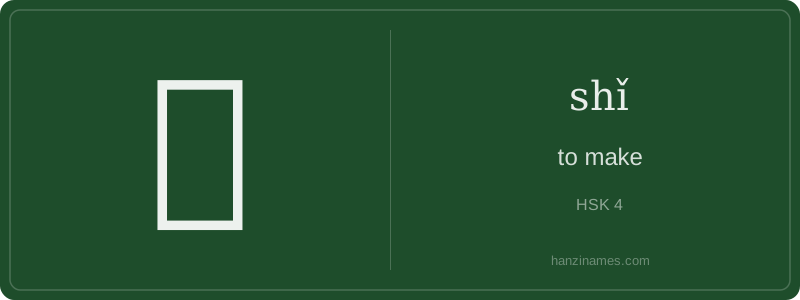
In daily Chinese, 使 appears constantly in formal and academic contexts: news reports ('这使问题更加复杂'), scientific writing ('该药物使细胞凋亡'), and official documents ('此举使协议生效'). It’s indispensable in HSK 4–6 grammar for expressing causation. A well-documented idiom is 使出浑身解数 (shǐ chū hún shēn jiě shù)—'to use every trick in the book'—attested in Qing-era novels like *The Scholars*. Historically, 使 was central to China’s tributary system: '遣使' (qiǎn shǐ) meant 'sending an envoy,' a term appearing over 1,200 times in the *Veritable Records of the Ming Dynasty*.
The character evolved from seal script (c. 3rd c. BCE), where 史 (shǐ, 'scribe/historian') was already a phonetic-semantic compound. 使 borrowed 史’s pronunciation and added 亻 to specify 'a person acting as agent.' No oracle bone form survives—its earliest attestation is in Warring States bamboo texts. Today, learners most often encounter it in classroom drills like 'A使B+V' sentence patterns.
As an archaeologist brushing dust from a Han dynasty bamboo slip, I find 使 etched with confident, clerical-script strokes—its left side 亻 (person) anchoring it in human agency, its right side 史 (history, scribe) revealing its original bureaucratic soul: 'one who carries out orders.' This wasn’t just 'to make'—it was 'to dispatch an envoy,' 'to enact imperial will.' The character breathes with the weight of diplomatic missions to the Xiongnu and Tang envoys sailing to Silla.
Excavating further, bronze inscriptions from the Warring States show 使 already functioning as a causative verb—'to cause [someone] to do [something].' Unlike spontaneous action verbs, 使 always implies intentionality and mediation: not 'he ran,' but 'he made her run.' Its grammatical role as a *causative verb* is archaeologically consistent across 2,300 years—no semantic drift, only deepening precision.
The radical 亻 confirms its anthropocentric core: no person, no 使. Even in modern usage, 使 never acts alone—it requires both a subject (the causer) and an object (the caused). This syntactic rigidity mirrors ancient ritual protocols: an envoy (使) must be appointed by authority and entrusted with a specific charge. The character thus preserves a grammar of responsibility—one that still structures Mandarin sentences today.
Example Sentences
Common Compounds
Similar Characters — Don't Mix These Up
Your First Step into Chinese Culture: Get a Chinese Name
Every journey into Chinese begins with a name. Use our free Chinese name generator to create a meaningful, personalized Chinese name that fits you perfectly.
Get My Chinese Name →