量
Character Story & Explanation
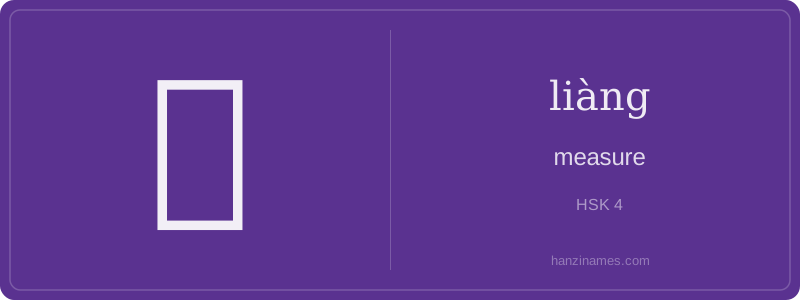
In daily life, 量 appears constantly in health contexts (e.g., 血糖量 ‘blood glucose level’), cooking (用量 ‘amount used’), and official documents (如‘限量供应’ ‘rationed supply’). It’s central to HSK 4 vocabulary and appears in idioms like ‘量力而行’ (‘act according to one’s ability’)—a Confucian principle codified in the Analects (6.26) and still quoted in business ethics training. Historically, standardized 量 vessels were mandated by Emperor Qin Shi Huang to unify weights and measures across China in 221 BCE.
The character’s earliest verified form appears in Warring States bamboo slips (c. 475–221 BCE) as a vessel with marked gradations. It was never a pictograph of sun + inside—it’s a functional logograph of a calibrated container. Modern usage leans heavily on its noun sense (‘quantity’) more than verb (‘to measure’), especially in scientific and administrative language.
Our detective begins at the crime scene: the character 量, pronounced liàng. At first glance, it looks like a sealed container—'里' (lǐ, 'inside') crowned by '日' (rì, 'sun'), but that top isn’t actually 日—it’s a stylized ancient measuring vessel lid. The radical 里 hints at internal capacity or contained space, not geography. Historically, 量 evolved from bronze inscriptions where it depicted a standard grain measure—a calibrated box with a cover—used in Zhou dynasty tax and trade systems.
By the Han dynasty, 量 had solidified into its modern structure: the upper component ( + 日-like shape) represents the lid and scale markings, while 里 conveys measured volume within defined boundaries. Unlike pictographs like 日 or 月, 量 is a phono-semantic compound—its sound element is now obscure, but its meaning element is unambiguous: quantification through standardization. This reflects China’s early bureaucratic obsession with uniformity—from Qin dynasty weights to Tang land surveys.
Though often misread as ‘sun-inside’, the top part is actually a fused glyph representing measurement tools: two horizontal lines (scale marks) above a simplified vessel outline. Its 12 strokes encode precision—not randomness. Each stroke has purpose: the three dots on the left of the top section symbolize calibration points; the final horizontal stroke of 里 grounds the concept in tangible, earthly standards. This isn’t poetry—it’s proto-engineering in script form.
Example Sentences
Common Compounds
Similar Characters — Don't Mix These Up
Your First Step into Chinese Culture: Get a Chinese Name
Every journey into Chinese begins with a name. Use our free Chinese name generator to create a meaningful, personalized Chinese name that fits you perfectly.
Get My Chinese Name →