社
Character Story & Explanation
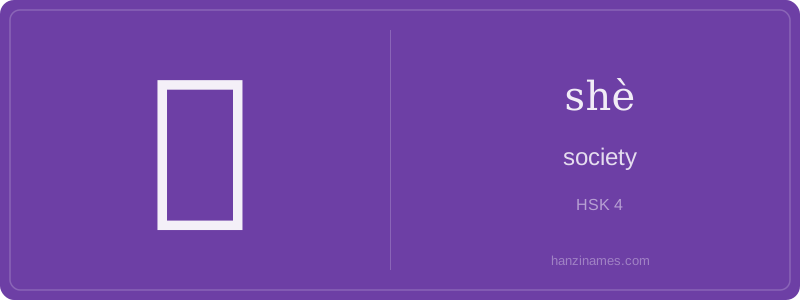
In Beijing’s hutongs, residents gather weekly at their 社区居委会 (shèqū jūwěi huì) — the ‘community residents’ committee’, a legally mandated grassroots organization under China’s Urban Residents’ Committee Organization Law (1989). The character 社 appears in over 20 official administrative terms, including 社保 (social insurance) and 社工 (social worker), reflecting its institutional centrality. A common idiom is 社会主义 (shèhuì zhǔyì, socialism), where 社 anchors the ideological framework of organized societal development.
The character 社 originated as a pictograph of an altar (礻) beside a field (土), representing the ancient ‘She altar’ for worshipping the Earth God — documented in bronze inscriptions from the Western Zhou dynasty (c. 1046–771 BCE). By the Warring States period, it had acquired the meaning ‘group bound by shared ritual or territory’, later generalizing to ‘organization’ and ‘society’.
The character 社 (shè) embodies the deep-rooted Chinese value of collective life — not just 'society' as an abstract concept, but the tangible networks that hold communities together. Historically tied to earth deities and village altars, it evolved into a linguistic cornerstone for any formally organized group: from neighborhood committees to tech startups. Its radical 礻 (shì), meaning 'altar' or 'ritual', signals its spiritual and communal origins — a reminder that in Chinese thought, organized human life is inherently sacred and relational.
Today, 社 appears everywhere in modern China: on WeChat group names, university club banners, and government office plaques. It’s never neutral — it implies purpose, membership, and shared responsibility. Whether you’re joining a calligraphy society (书法社) or reporting to your residential community committee (社区), 社 marks the boundary between individual existence and collective identity. This duality makes it essential for HSK 4 learners navigating real-world social structures.
Unlike English ‘society’, which often connotes broad demographics or socioeconomic strata, 社 carries operational weight: it denotes an active, registered, or functionally organized entity. That’s why it appears in compound words like 社交 (social interaction) and 社保 (social insurance) — always implying structured engagement. Mastering 社 unlocks fluency not just in vocabulary, but in understanding how Chinese institutions and everyday relationships are formally constituted and named.
Example Sentences
Common Compounds
Similar Characters — Don't Mix These Up
Your First Step into Chinese Culture: Get a Chinese Name
Every journey into Chinese begins with a name. Use our free Chinese name generator to create a meaningful, personalized Chinese name that fits you perfectly.
Get My Chinese Name →