全
Character Story & Explanation
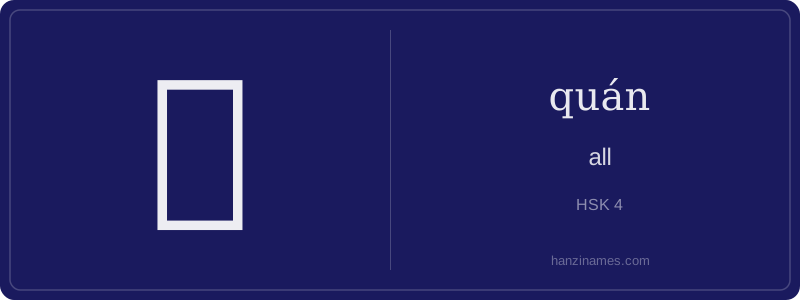
全 is ubiquitous in modern Chinese: it appears in official slogans (e.g., 全面建成小康社会 — 'build a moderately prosperous society in all respects'), daily expressions (全场安静!— 'Silence for the entire venue!'), and common idioms like 一见钟情,两全其美 (love at first sight, and a win-win solution). The idiom 两全其美 (liǎng quán qí měi) — literally 'satisfy both sides completely' — has been documented since the Ming dynasty and remains widely used in negotiations and compromise scenarios.
The character’s earliest attested form appears in bronze inscriptions of the Western Zhou (c. 1046–771 BCE), where it depicted a person (人) under a roof (宀), symbolizing 'a person safe and intact at home'. Later, the seal script simplified it to its current shape — with the radical 入 (enter) on top and 王 (king) below — though this structure is now understood as phonetic-semantic rather than pictographic. Modern learners encounter 全 constantly — from subway announcements (‘本列车全程运行’ — ‘This train runs the full route’) to app notifications (‘已下载全部文件’ — ‘All files downloaded’).
The Chinese character 全 (quán) means 'all', 'entire', or 'complete' — conveying totality and wholeness without exception. Unlike English words like 'all' that function primarily as determiners or pronouns, 全 is highly versatile: it appears as a prefix in compound words (e.g., 全部, 全面), functions as an adjective ('full/complete'), and even serves as a verb meaning 'to preserve intact' in classical usage. Its semantic scope bridges quantitative inclusivity and qualitative integrity — closer to the philosophical notion of 'the undivided whole' than mere numerical totality.
In Western thought, equivalents like 'all' (English), 'tout' (French), or 'alles' (German) emphasize scope or quantity but rarely carry connotations of moral or physical integrity. By contrast, 全 often implies ethical completeness — as in 全人教育 (holistic education), reflecting Confucian ideals of cultivating the whole person. This resonates with Greek 'holos' (whole) but adds a distinctly relational, societal dimension: being 'whole' means fulfilling one’s roles fully within family, community, and state.
Culturally, 全 evokes harmony, balance, and auspiciousness — seen in festival phrases like 新年快乐,万事如意,全家幸福 (Happy New Year, may all go well, and may the whole family be happy). It appears in legal, medical, and technological domains (e.g., 全民医保 — universal health insurance; 全息技术 — holography), where 'completeness' signifies comprehensiveness and reliability. Unlike Western binaries (e.g., 'partial vs. total'), 全 operates on a spectrum of realization: something can be 全面 (comprehensive) without being absolutely exhaustive — emphasizing functional wholeness over mathematical totality.
Example Sentences
Common Compounds
Similar Characters — Don't Mix These Up
Your First Step into Chinese Culture: Get a Chinese Name
Every journey into Chinese begins with a name. Use our free Chinese name generator to create a meaningful, personalized Chinese name that fits you perfectly.
Get My Chinese Name →