与
Character Story & Explanation
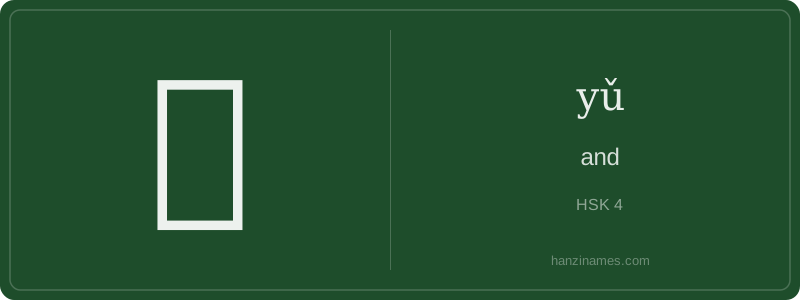
In daily life, 与 appears constantly in formal signage, business documents, and media. For example, official announcements like ‘北京市政府与天津市人民政府签署合作协议’ (Beijing Municipal Government and Tianjin Municipal Government signed a cooperation agreement) use 与 to denote institutional parity. It’s also central in common idioms like 与时俱进 (yǔ shí jù jìn, ‘keep pace with the times’) and 与人为善 (yù rén wéi shàn, ‘be kind to others’), both listed in authoritative dictionaries like the Xiandai Hanyu Cidian.
Historically, 与 evolved from Oracle Bone Script forms depicting ‘a hand offering something to another person’ — confirmed by paleographic studies (e.g., *Shuōwén Jiězì* commentary and modern scholarship by Qiu Xigui). Though simplified today to three strokes, its original pictographic essence — mutual giving or joining — remains core to its meaning of ‘together with’ and ‘and’ in balanced relationships.
The character 与 (yǔ) is a deceptively simple yet profoundly relational word in Chinese — just three strokes, yet it binds people, ideas, and actions. Unlike the English 'and', which often just links nouns, 与 carries a subtle nuance of equality and mutual participation: it’s not merely ‘A and B’, but ‘A together with B’ — implying shared agency or status. You’ll see it everywhere in formal writing, contracts, academic papers, and news headlines where precision and balance matter.
Its alternate pronunciation yù appears only in classical or literary contexts — most notably in the phrase 与人为善 (yù rén wéi shàn), meaning ‘to be kind to others’, where 与 functions as ‘to give’ or ‘to bestow’. This archaic usage survives in idioms and Confucian texts but is absent from modern spoken Mandarin. Learners should master yǔ first — it accounts for over 99% of contemporary usage.
As an HSK Level 4 character, 与 signals a shift from basic vocabulary to more sophisticated syntax. It rarely stands alone; instead, it pairs nouns or noun phrases in formal coordination — think of it as the ‘diplomatic conjunction’: respectful, balanced, and unobtrusive. Its minimalist form (一 + + 丶) reflects its function: a horizontal base (radical 一) grounding two equal parties, connected by a gentle hook and dot — visual harmony mirroring semantic partnership.
Example Sentences
Common Compounds
Similar Characters — Don't Mix These Up
Your First Step into Chinese Culture: Get a Chinese Name
Every journey into Chinese begins with a name. Use our free Chinese name generator to create a meaningful, personalized Chinese name that fits you perfectly.
Get My Chinese Name →