各
Character Story & Explanation
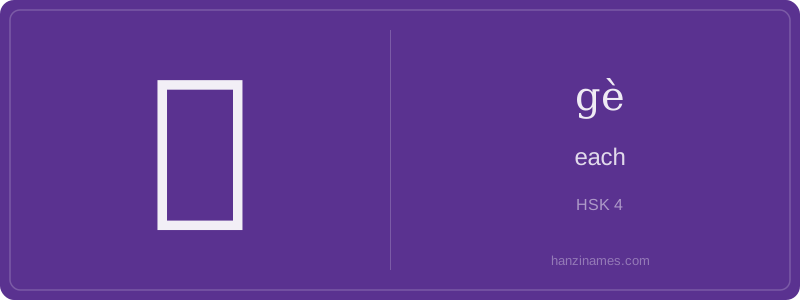
各 is ubiquitous in modern Chinese administrative, educational, and commercial language: e.g., 各地 (gè dì, 'various places'), 各行各业 (gè háng gè yè, 'all trades and professions'), and official documents like the PRC Constitution (Article 4: '各民族一律平等' — 'All ethnic groups are equal'). It appears frequently in headlines, policy statements, and school curricula — especially at HSK 4 level, where learners encounter compound structures requiring distributive clarity.
The character’s earliest attested form appears in Warring States bamboo slips (475–221 BCE) as a compound of 口 (kǒu, 'mouth') and 夂 (zhǐ, an archaic component indicating movement toward). Scholars (e.g., Xu Shen in *Shuōwén Jiězì*, 121 CE) analyzed it as 'to arrive at each mouth' — metaphorically 'reaching every person', later generalized to 'each'. While not a pictograph, its structure reflects early conceptualization of inclusive address.
The Chinese character 各 (gè) means 'each' or 'every' and functions primarily as a distributive quantifier—emphasizing individual members within a group. Unlike English 'each', which can stand alone as a pronoun ('Each has arrived'), 各 must attach to a noun or measure word (e.g., 各国 gè guó, 'each country') and rarely appears without a following noun. Its grammatical role is tightly bound to collective contexts, reflecting Chinese’s preference for explicit nominal anchoring over abstract pronominal use.
In Western thought, 'each' often carries philosophical weight—think of Kant’s 'treat humanity as an end in itself, never merely as a means', where 'each person' implies moral singularity. 各 lacks this overt ethical framing; instead, it signals logistical or administrative distribution: 'each department', 'each semester', 'each branch'. It’s pragmatic, not poetic—common in policies, schedules, and data reporting rather than literature or ethics texts.
Culturally, 各 reinforces collectivist precision: acknowledging individuals *within* the group, not apart from it. Compare Latin 'unusquisque' (each one) — which emphasizes discrete identity — with 各, which presupposes membership in a named set (e.g., 各省 'each province' implies China’s administrative structure). This mirrors Confucian relational ontology: a person is defined by their position among others, not in isolation. Thus, 各 subtly encodes social embeddedness even in its grammar.
Example Sentences
Common Compounds
Similar Characters — Don't Mix These Up
Your First Step into Chinese Culture: Get a Chinese Name
Every journey into Chinese begins with a name. Use our free Chinese name generator to create a meaningful, personalized Chinese name that fits you perfectly.
Get My Chinese Name →