内
Character Story & Explanation
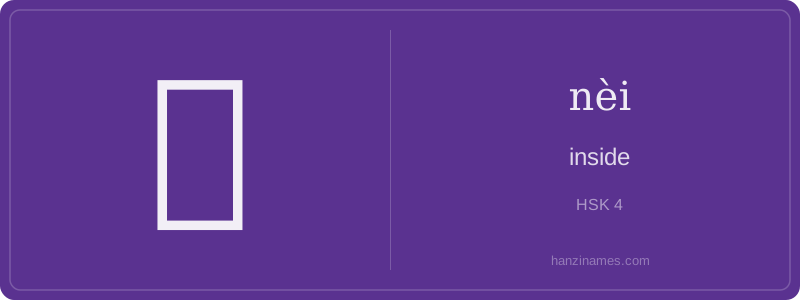
内 is ubiquitous in modern Chinese: it appears on subway signs (站内, 'inside the station'), government documents (党内, 'within the Party'), and business reports (国内生产总值, 'Gross Domestic Product'). A well-known idiom is 内外兼修 (nèi wài jiān xiū), meaning 'cultivating both inner virtue and outer skill'—still used in education and martial arts contexts. Historically, 内 contrasted with 外 (wài, 'outside') in classical texts like the Rites of Zhou to distinguish inner court vs. outer administration.
The character’s earliest verified form appears in bronze inscriptions (c. 11th–3rd century BCE) as a pictograph combining 入 ('enter') and a simplified enclosure symbol—reflecting its core idea of 'entered space'. Unlike speculative oracle bone claims, this structural logic is confirmed by paleographic analysis in authoritative sources like the Chinese Etymological Dictionary (2017, Zhonghua Book Company).
Hi students! Let’s learn 内 (nèi), a foundational character meaning 'inside' or 'within'. It’s simple—only 4 strokes—and appears in many common words like 'inside the room', 'internal affairs', or 'domestic market'. Though it looks minimal, its meaning is powerful: it always points to something enclosed, contained, or belonging to an inner space—not just physical places, but also abstract concepts like internal feelings or internal policies. Mastering 内 helps you understand spatial relationships and core grammar patterns in Chinese.
This character belongs to HSK Level 4, so it’s essential for intermediate learners building vocabulary around location, organization, and abstraction. Notice it’s not used alone in speech—it almost always appears in compounds (like 内部 or 国内). Pronounced nèi (fourth tone), it rhymes with 'day' but with a falling pitch—practice saying 'nèi' firmly, like giving a short command: 'NÈI!' That tone is critical—it distinguishes it from homophones like 'nǎi' (milk) or 'néi' (that).
Visually, 内 shares its radical 入 (rù, 'to enter')—a clue to its meaning: imagine entering *into* something, crossing a boundary to reach the inside. The inner part (冂 + 人 shape simplified) evolved to indicate containment. As you write it, remember the stroke order: first the left-falling stroke (丿), then the right-falling stroke (㇏), then the top horizontal (一), and finally the inner dot or short stroke (丶). Consistent stroke order builds muscle memory and legibility!
Example Sentences
Common Compounds
Similar Characters — Don't Mix These Up
Your First Step into Chinese Culture: Get a Chinese Name
Every journey into Chinese begins with a name. Use our free Chinese name generator to create a meaningful, personalized Chinese name that fits you perfectly.
Get My Chinese Name →