将
Character Story & Explanation
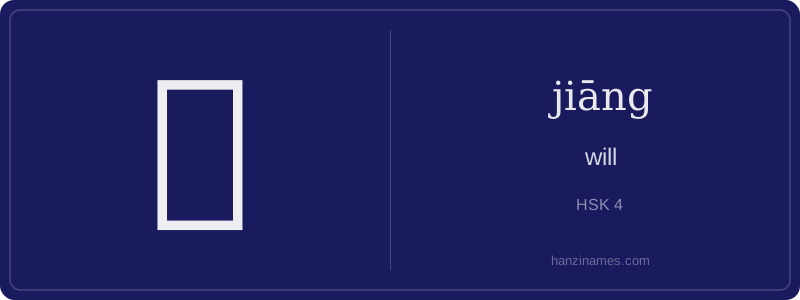
将 is indispensable in formal written Chinese: news headlines (“台风将登陆”), legal documents (“本协议将于生效”), and literary narration (“他将启程北上”). It appears in six HSK-4+ idioms, including 将信将疑 (‘half-believing, half-doubting’) and 挥金如土 (though not containing 将, it’s often misattributed—correct examples include 将功折罪, ‘offset crimes with merits’). In daily life, native speakers prefer 会 or 要 for spoken future, reserving 将 for solemnity or precision.
The character’s earliest verified form (Western Zhou bronze script) depicts a hand grasping a banner—symbolizing military leadership. This origin is confirmed by Shuōwén Jiězì (121 CE), which defines 将 as ‘to lead an army,’ linking it to the ancient role of a general (jiàng). No oracle bone form survives, but bronze evidence is robust and unambiguous.
Our detective begins at the crime scene: the character 将, first attested in bronze inscriptions of the Western Zhou (c. 1046–771 BCE). Early forms show a hand (又) gripping a weapon or banner—suggesting command, not mere prediction. This fits its core semantic field: authoritative action, not passive futurity. The ‘will’ meaning emerged later as a grammaticalized function word, evolving from its original sense of ‘to lead troops’ or ‘to take charge.’
The radical 丬 (‘left side of a garment’) is a later clerical simplification—it originally derived from the pictograph of a banner or standard (), later stylized and merged with the hand component. By the Han dynasty, 将 stabilized into its modern shape: a hand holding something decisive. Its three readings—jiāng (future auxiliary), jiàng (military commander), and qiāng (archaic, ‘to offer’)—reflect distinct semantic branches preserved phonologically.
Crucially, 将 never meant ‘will’ in the English modal sense until it grammaticalized as a future marker during the late Tang and Song dynasties. Unlike English ‘will,’ it doesn’t express volition alone—it signals intention backed by agency, often with implied immediacy or formality. This nuance explains why 将 is rare in casual speech today but thrives in written Chinese, formal announcements, literature, and fixed expressions like 将心比心 (‘put oneself in another’s place’).
Example Sentences
Common Compounds
Similar Characters — Don't Mix These Up
Your First Step into Chinese Culture: Get a Chinese Name
Every journey into Chinese begins with a name. Use our free Chinese name generator to create a meaningful, personalized Chinese name that fits you perfectly.
Get My Chinese Name →