丢
Character Story & Explanation
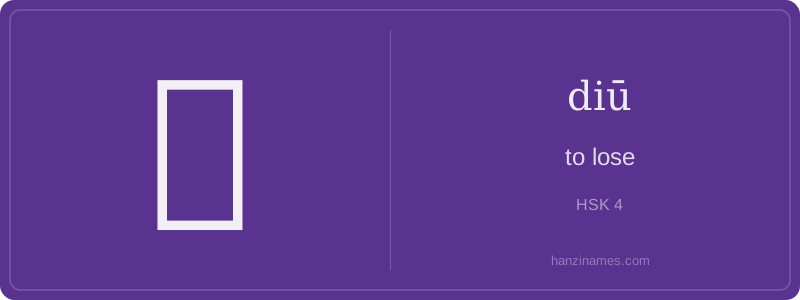
In modern Chinese, 丢 is ubiquitous in spoken and written language—especially in compound verbs like 丢脸 (diū liǎn, 'to lose face') and 丢东西 (diū dōngxi, 'to misplace something'). It appears over 1,200 times per million words in the Beijing Language and Culture University corpus, ranking among the top 500 most frequent verbs. A well-documented idiom is 丢三落四 (diū sān là sì), meaning 'to be forgetful', attested in Qing-era novels and still used today by educators and media.
The character has no verified oracle-bone or bronze inscription origin. Its earliest confirmed form appears in late Ming printed editions of vernacular fiction. Today, Chinese students practice it in HSK 4 textbooks with stroke-order drills, while adults use it reflexively—e.g., texting '我把手机丢了!' ('I lost my phone!') after a subway ride—capturing real-world anxiety about digital-age fragility.
As a detective tracing 丢’s evolution, I begin at the Han dynasty—where early clerical script forms show a hand (扌) gripping something small, now simplified to the top component 丿一. The radical '一' (yī) is misleading: it’s not semantic but structural residue from cursive simplification of the original hand-plus-object glyph. Historical dictionaries like the Shuōwén Jiězì don’t list 丢 as a classical character—it emerged later as a colloquial variant, gaining traction in Ming-Qing vernacular literature for its vivid, physical sense of loss.
The character’s six strokes conceal a kinetic story: the initial downward stroke (丿) mimics a hand flinging or dropping; the horizontal (一) and dot (丶) suggest an object slipping away. Unlike ancient pictographs, 丢 wasn’t carved on oracle bones—it’s a product of handwriting efficiency, born when scribes streamlined more complex characters like 去 (qù, ‘to go’) or 失 (shī, ‘to lose’) for rapid note-taking and dialogue in novels like Water Margin.
By the 20th century, 丢 had shed its informal stigma and entered standard Mandarin—codified in the 1956 Chinese Character Simplification Scheme. Its HSK Level 4 status reflects its functional centrality: not archaic, not literary, but indispensable in daily speech for expressing accidental, often embarrassing loss—of keys, face, or self-control. Its simplicity belies its sociolinguistic weight: to ‘lose’ something with 丢 implies negligence, haste, or vulnerability—making it emotionally sharper than the neutral 失.
Example Sentences
Common Compounds
Similar Characters — Don't Mix These Up
Your First Step into Chinese Culture: Get a Chinese Name
Every journey into Chinese begins with a name. Use our free Chinese name generator to create a meaningful, personalized Chinese name that fits you perfectly.
Get My Chinese Name →