亚
Character Story & Explanation
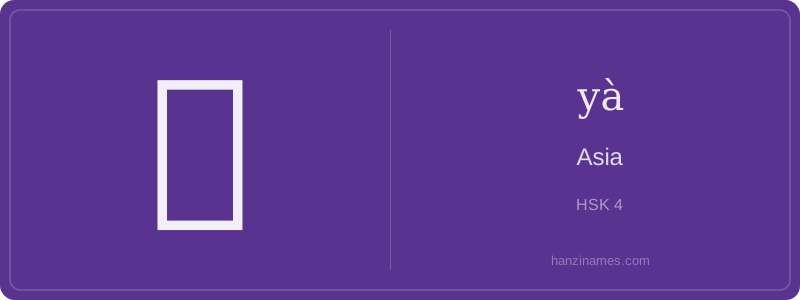
In modern Chinese, 亚 is ubiquitous in geographical, institutional, and competitive contexts: ‘Asia’ (亚洲), ‘Asian Games’ (亚运会), and ‘sub-’ prefixes like 亚军 (runner-up). It appears in official names (e.g., 亚洲开发银行 — Asian Development Bank) and everyday speech (e.g., 东亚 — East Asia). The idiom 亚于 (yà yú, 'inferior to') remains common in formal writing and exams, reflecting its classical ordinal sense.
The character’s form has no verified pictographic origin. Unlike sun (日) or tree (木), 亚 evolved as a stylized logogram during the Warring States period, likely abstracted from earlier tally or rank markers. Today, Chinese students learn it early in HSK 4 as part of geographical vocabulary—and immediately recognize it on Olympic medals, news banners, and subway maps labeling regional lines.
As an archaeologist brushing dust from a Han dynasty bamboo slip, I find 亚 etched not as a map of continents, but as a geometric glyph—symmetrical, grounded, and deliberate. Its six strokes form a balanced enclosure: two horizontal lines (radical 一) framing a central crossbar and descending legs. This isn’t a pictograph of mountains or rivers—it’s a schematic symbol of order and secondary rank, later repurposed for ‘Asia’ through phonetic loan. Early inscriptions show it denoting ‘second in sequence’ or ‘subordinate’, long before geopolitical naming.
The character’s earliest attested use appears in Warring States texts like the *Guodian Chu Slips*, where 亚 functions as a numerical classifier meaning ‘second’—as in 亚圣 (‘Second Sage’, referring to Mencius). Its structural simplicity belies semantic weight: the radical 一 (one) anchors it in unity, while the internal structure suggests division or hierarchy beneath the surface. No oracle bone forms survive, confirming its late emergence—likely standardized during Qin unification as part of script reform.
What makes 亚 archaeologically compelling is its semantic pivot: from abstract ordinal marker to continental proper noun. When 19th-century Chinese scholars translated Western geographical terms, they selected 亚 for ‘Asia’ not for visual resemblance, but because its pronunciation yà matched the final syllable of ‘Asia’ and its connotation of ‘adjacent’ or ‘secondary’ aligned with East Asian cosmological positioning relative to ‘central’ China. Thus, 亚 became a linguistic artifact of cross-cultural encounter—not ancient origin, but adaptive reinvention.
Example Sentences
Common Compounds
Similar Characters — Don't Mix These Up
Your First Step into Chinese Culture: Get a Chinese Name
Every journey into Chinese begins with a name. Use our free Chinese name generator to create a meaningful, personalized Chinese name that fits you perfectly.
Get My Chinese Name →