仍
Character Story & Explanation
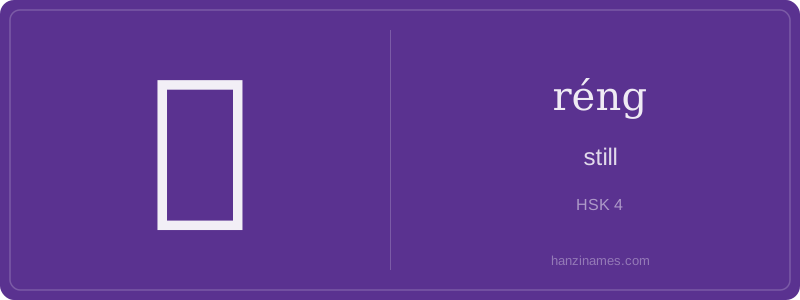
仍 is widely used in formal written Chinese: news headlines ('经济仍面临压力' — 'The economy still faces pressure'), policy documents, and academic writing. It appears in the idiom 仍然如此 (réngrán rúcǐ) — 'still so', commonly used to stress unchanged reality despite expectations. Historically, 仍 first appeared in bronze inscriptions of the Zhou dynasty (c. 1046–256 BCE) as a phonosemantic compound: the 亻 radical signals human-related action, and the right component (乃 nǎi) serves mainly as a phonetic hint (though pronunciation shifted over time).
The character’s form has remained remarkably stable for over 2,500 years. Unlike many characters that evolved dramatically, 仍 retains its original structure—evidence of its functional consistency in expressing continuity. Modern speakers use it daily in formal contexts, such as reporting on persistent issues (e.g., pollution, inflation) where emphasis on endurance matters.
Hello, learners! Let’s explore 仍 (réng), a small but powerful character meaning 'still' or 'yet'. Though it has only four strokes and looks simple, it carries important nuance—it expresses continuity despite expectation or change. Think of it as the quiet persistence in a sentence: something continues to be true even when you might expect it to stop. It often appears after verbs or adjectives to show that a condition remains unchanged.
Notice its radical: 亻 (the 'person' radical). This hints that 仍 originally related to human action or state—indeed, in classical texts, it conveyed 'to continue doing something despite difficulty'. Today, it’s never used alone; it always appears in compounds or after other words, like a subtle anchor holding meaning steady across time or circumstance.
Unlike English ‘still’, which can be an adverb or adjective, 仍 is strictly an adverb in modern Chinese—and it’s formal or literary. You’ll hear it more in news reports, essays, or official speech than in casual chats (where people often use 还 hái instead). That makes it especially valuable for HSK 4 learners aiming for precision and stylistic range. Mastering 仍 helps you sound thoughtful, measured, and authentically Chinese.
Example Sentences
Common Compounds
Similar Characters — Don't Mix These Up
Your First Step into Chinese Culture: Get a Chinese Name
Every journey into Chinese begins with a name. Use our free Chinese name generator to create a meaningful, personalized Chinese name that fits you perfectly.
Get My Chinese Name →