价
Character Story & Explanation
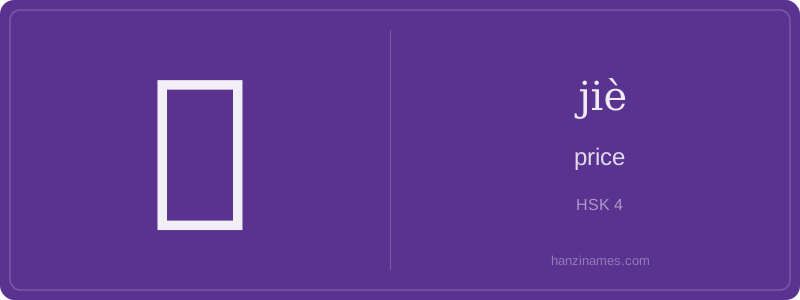
In daily life, 价 is overwhelmingly used in price-related contexts: 价格 (jiàgé, 'price'), 降价 (jiàngjià, 'to lower price'), and 无价之宝 (wújià zhī bǎo, 'priceless treasure'). It appears in signage ('特价' — tèjià, 'special price'), e-commerce ('促销价' — cùxiāojià, 'promotional price'), and official documents like tax invoices. Historically, 价 appears in Ming-Qing merchant ledgers and Qing dynasty customs records, consistently paired with numerals and units of currency. The idiom 价值连城 (jiàzhí lián chéng, 'worth a city') dates to the Warring States period, attesting to early abstraction of value.
The character is a phono-semantic compound: 亻 (human radical) + 介 (jiè, phonetic and semantic base meaning 'to intervene' or 'serve between'). While not a pictograph, its structure reflects its original function — a person (亻) acting as intermediary (介), hence 'messenger' or 'agent'. No oracle bone or bronze script forms survive for 价; it first appears reliably in clerical script (lìshū) during the Han dynasty.
Our detective begins at the crime scene: the character 价. At first glance, it appears deceptively simple — just six strokes, a human radical (亻) on the left and the phonetic component 介 (jiè) on the right. But wait: the 'basic meaning' given — 'messenger; servant' — is a red herring for modern learners. That sense survives only in classical texts and rare compounds like 价人 (jièrén), an archaic term for envoy or attendant. The radical 亻 confirms its human-related semantics, while 介 historically meant 'to intervene' or 'to serve between parties', fitting the role of a go-between or intermediary.
The real twist emerges in pronunciation. Though listed as jiè, the dominant modern reading is jià — used in over 95% of contemporary speech, especially in price-related terms. This shift reflects semantic broadening: from 'intermediary who sets value' to 'the value itself'. Linguistic forensics show that during the Tang and Song dynasties, 价 increasingly appeared in commercial documents denoting 'assigned worth', gradually displacing older characters like 賈 (gǔ) for pricing. The jiè reading now functions almost exclusively in literary or historical registers.
Our detective concludes that 价 is a case of semantic migration disguised as orthographic stability. Its written form never changed, but its functional core did: from human agent (servant/messenger) to abstract concept (value/price). This mirrors broader shifts in Chinese economic history — as markets formalized, the 'messenger of value' became synonymous with 'value itself'. Even today’s HSK-4 learners encounter 价 almost exclusively in price contexts, unaware they’re wielding a fossilized social role encoded in ink.
Example Sentences
Common Compounds
Similar Characters — Don't Mix These Up
Your First Step into Chinese Culture: Get a Chinese Name
Every journey into Chinese begins with a name. Use our free Chinese name generator to create a meaningful, personalized Chinese name that fits you perfectly.
Get My Chinese Name →